


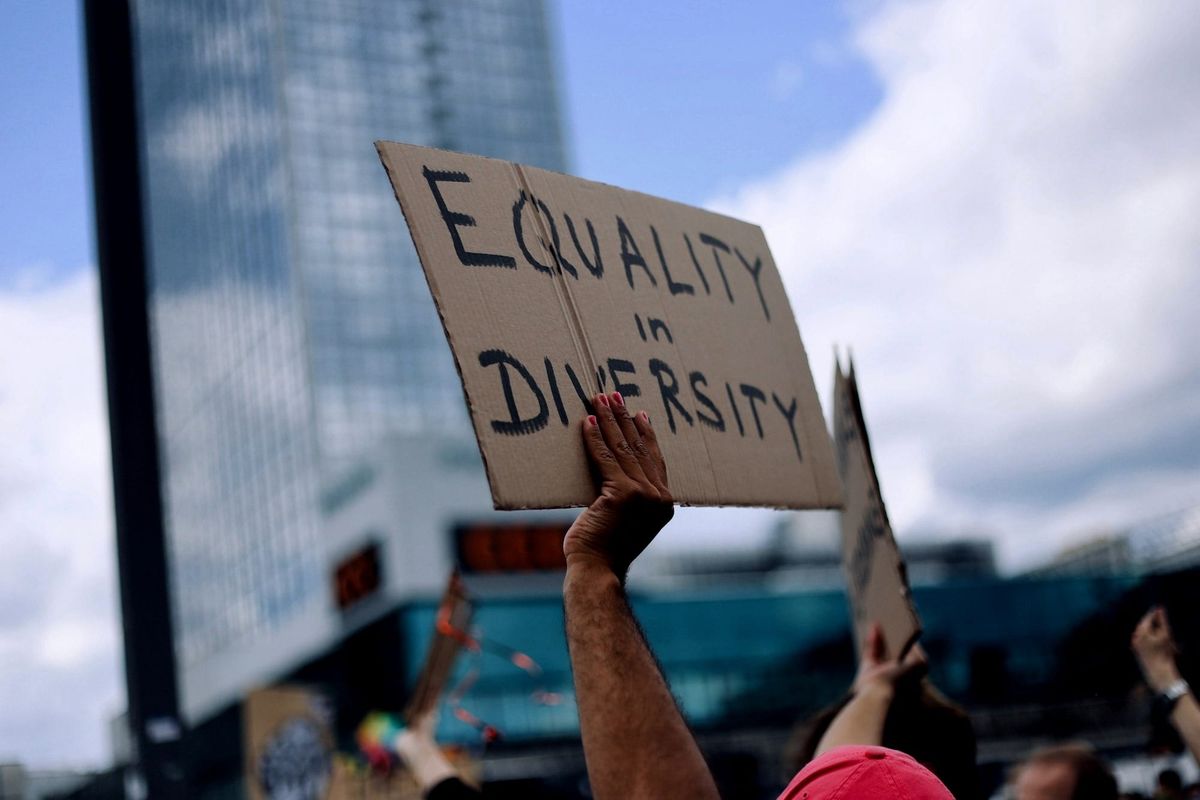
The main theme of this issue of Transform Review is the relationship between a politics that centres class and one that emphasises differences – for instance, ethnicity and gender – other than class. It has been the subject of public debate for many years, as it is closely linked to the strategy of the transformative left. There is a tension within the left academy, parties, and social movements around these two poles. Given your longstanding participation in this discussion, your perspective on this tension would be of great interest.
NF I want to start out by rejecting any framing of the question as identity politics or class politics – as an antithesis, as an opposition; identity politics and class politics are not mutually exclusive. There are no class struggles or working-class movements that have not actually mobilised around an identity, a class identity, or a national identity, or some kind of industrial identity or whatever. There are no social movements that don't project some image of who the collective actor is and what characterises it. But that's very different from saying that identity is the sole object of the struggle. It's one thing to say every movement projects an identity, and another thing to say that movements struggle for nothing except the recognition, respect, validation of their identity.
Now, the question is, are there movements in the present era and in the recent past that have been concerned only with identity in that sense? And if so, are they problematic? And what is their relation to class struggle? The first thing I want to say is that it is a mistake to understand feminist movements or antiracist movements, just to take two very important examples, as simply concerned with identity. That is, when people criticise identity politics, they are often insinuating that feminists and antiracists only care about identity. But I think that both movements are concerned with deep, structural oppression. Gender and race are social divisions, axes of domination, injustice, and oppression, that are thoroughly structural and have real material elements. At their core, gender asymmetries are grounded in capitalism’s gender division of labour. The system hives off production from reproduction, and in that way casts women as inherently feminine, altruistic,
It is a mistake to understand feminist movements or anti-racist movements, just to take two very important examples, as simply concerned with identity.
and caring, while men are positioned as their opposite. As a result, women are materially disadvantaged in all kinds of ways. That's a social structural issue in the same way that Marxists view the division between capital and labour as socially structured.
The same is true for race or ethnic chauvinisms. These are grounded in another deep-structural feature of capitalist society: division within the working class between racialised, menial, degraded, coerced labour, on the one hand, and standard forms of exploited labour, on the other. Not that exploited labour is great, but it's not as bad as this kind of ‘sub-work’ that is assigned to racialised groups. That's also a material division and a structural division in the way that capitalism organises its labour system.
In general, then, it's a mistake to view feminist and antiracist movements as merely identity movements. And yet it’s true that, in the last 40 years, liberal currents of feminism and antiracism have downplayed the structural dimension. They’ve adopted a thin, legalistic, and formalistic ‘discrimination’ paradigm, which at best ends up promoting equality within the professional-managerial class, but not more broadly. Recall the liberal-corporate-feminist focus on ‘cracking the glass ceiling’ or ‘leaning in’ and the post-Civil Rights focus on getting ‘Black faces in high places’ to quote Keeanga Yamahtta-Taylor. Far from advancing social egalitarianism, these approaches promote equal-opportunity domination. Insofar as feminist and antiracist movements have been hegemonised by liberal currents, they downplayed their own material and class dimensions.
But there are problems, too, on the other side. Majority ethnic male-dominated industrial unions have often equated ‘the working class’ with white guys in factories. They have not always been receptive to organising unskilled workers, low paid precarious service workers, domestic workers, and migrant workers, who are disproportionately women and people of colour.
The upshot is that hegemonic currents within all these struggles have been led to adopt problematic views of what class and identity really are. What is needed, by contrast, is a deep rethinking of the categories of identity and class — and of the relations among them in capitalist societies. For me, that means abandoning the view of gender and race as alternatives to class, as if those three categories are simply given side-by-side. What I have just said implies that gender and race are, in fact, labour-based structural divisions within the working class in capitalism. That analytic insight can ground a new perspective unabashedly leftwing and politically inclusive.
In recent years, the term ‘woke politics’ has become a common part of public debate, often used — especially by critics — as a catch-all for identity politics. Some commentators even argue that one of the reasons for the sharp rise of the far right in both the United States and Europe is the fact that the Democratic Party in the United States, European social democracy, and the Greens have distanced themselves from class-based politics. Do you share this view? And how would you assess the role of identity politics in the current political conjuncture?
NF ‘Woke’ is a very disrespectful and misleading term, used by the US right indiscriminately to tar with a single brush all oppositional forces, whether they seek to transform microsocial cultural interactions or deep societal structures. So, I prefer not to use this language. But we still need to understand how the first of those orientations came to overshadow the second, both in the media and beyond.
In my view, important currents of various ‘new social movements’ became ensnared in a new political bloc, which I called ‘progressive neoliberalism’. Allied with financial and ‘symbolic’ capital, they were
Given [intersectionality’s political] impulse to develop a perspective that fosters greater cooperation, I’m fully on board. But instead of assuming that three distinct systems of oppressions ‘intersect’, we should ask where the categories of gender, race, and class come from — how they are generated, how they are produced. One account [is that] these categories emerge from the way capitalism organises labour through its signature institutionalised divisions.
effectively used to overlay a thin layer of progressive liberal egalitarianism — concerning gender, race, sexuality, and so on — on top of a predatory neoliberal political-economic agenda, which engineered a vast upward redistribution of wealth. This pattern is particularly evident in the United States, but also applies to New Labour in Britain, the German Social-Democratic Party (SPD), the French Socialist Party, and similar formations in other countries.
Specifically regarding the United States, in my article titled ‘Is Trumpism a New Normal?’, published in the second issue of transform review, I mention that the Democratic Party, by sidelining its left wing and choosing centrist candidates instead of Bernie Sanders in three election cycles (2016, 2020, and 2024), has alienated the working class — a fact that largely explains the shift to the far right and the recent victory, for the second time, of Donald Trump.
But I do know that the Democratic Party — and the American left more broadly — would be in much better shape if Sanders’s supporters had had the opportunity to build that movement, even if this hadn’t resulted in an electoral victory in the presidential elections.
Something like this has happened in many countries in Europe and elsewhere, where social democrats have fought to disable their own left wings, even when that meant handing victory to the right. In some cases, independent left collectivities have been built. The outstanding example is La France Insoumise which built the Nouveau Front Populaire (NFP) and made a very strong electoral showing, even though they've still been excluded from power. That example shows that while opportunities exist in some places, the social-democratic establishment remains a significant obstacle. It's unwilling to accept the fact that it's basically a dead option. No one wants it. No one believes in it.
OK, social democrats need to move out of the way and let another left — a real left — develop. But what about the movements? How can they avoid falling into the trap of progressive neoliberalism?
NF While I just criticised the Democratic Party and the so-called donor class — the big money — in the US, I also noted that significant segments of feminist, antiracist, and LGBTQ+ movements, have, in various ways, been complicit with progressive neoliberalism. They’ve got tunnel-vision, focused on their own ‘forms of discrimination’, without fully grasping how these fit into the broader systemic picture.
So, how can the movements avoid falling into that trap now? I think there are already some promising examples. I can’t avoid mentioning Zohran Mamdani’s victory, in the Democratic primary for the New York City mayoral race [Editor’s note: which he then won]. Not surprisingly, the investor and business classes are aggressively targeting him, weaponising baseless accusations of antisemitism and the like. So, there’s still a big fight ahead. And it’s true that New York City isn’t representative of America as a whole, so maybe we can’t generalise easily. But Mamdani has shown a possible path forward. He focused on the affordability of life in the city. This reminds me of David Harvey’s concept of the ‘right to the city’ — the struggle to avoid being squeezed out by rising housing costs, poor public transportation, dreadful commutes, increasing utility prices, food insecurity, and declining services. It’s fundamentally about quality of life in the city, but with a strong class dimension that resonates deeply with immigrants and communities of colour, Arabs, Jews, and many others. Since New York is a city full of people from all over, Mamdani’s message speaks to nearly everyone.
Another important aspect of his approach was his willingness to take a firm stand for Palestinian rights and against Israel’s genocide in Gaza, while also expressing empathy for Jewish concerns about antisemitism. He modelled the idea that fighting for Palestinian rights and antisemitism are not the same thing. This distinction is very important for our current moment. It suggests a way of connecting material harms (dispossession, starvation, murder) with failures of recognition and denials of humanity of Palestinians, above all, but also — in some circles — of Jews. Contrary to the misleading class-identity dichotomy, Mamdani demonstrated a way to connect concerns across both spheres. Without romanticising or idealising him or his prospects, his approach — rooted in a strong materialist perspective focused on everyday life — offers something powerful. Of course, we would need a different version of it for rural areas, since his campaign is focused on the city. But still, the focus on daily life, the environment, the social services, access to nutritious, affordable locally grown good food, housing — these are class issues, to be sure. But they are simultaneously issues of social reproduction, democracy, ecology, gender, and race/ethnicity, migrants rights, and more. If Mamdani’s campaign demonstrated the possibility of bringing together race and class politics, a somewhat different convergence was created not so long ago by Argentine feminists. In the years before the tragic rise of far-right president Javier Milei, their movement connected issues of gender-based violence with the neoliberal assault on social reproduction, especially the violence of austerity and ‘murder by debt’ through the dismantling of public services. They refused to treat these issues as separate. Instead, they made a distinctly pro-working-class feminism the face of a broader anti-austerity struggle. This is another powerful example of overcoming the false dichotomy between class and identity.
Do you believe that bringing together identity and class politics aligns with the meaning of the concept of intersectionality? And do you think that intersectionality serves the vision of the radical left to change the world, or does it risk further fragmentation of the movements, as some argue?
NF That’s a very good question. I’d like to distinguish between the political impulse behind the theory of intersectionality and its conceptual framework. I’m strongly in favour of the political impulse, which I take to be about fostering greater cooperation and coordination among social movements that have too often been disconnected — or even, in some cases, hostilely polarised one against the another. This is especially true when it comes to movements that identify themselves as class-based, (supposedly) opposed to those focused on gender, sexuality, race, ethnicity, or anticolonialism. Given the impulse to develop a perspective that fosters greater coordination and cooperation, then I’m fully on board.
That said, I do have a qualification: there are many different versions of intersectionality theory out there, and they’re not all the same. Some of them still follow an older model — one that dates back to the 1970s, which I recall from my days in the New Left — known as dual- or triple-systems theory. According to that view, there are, say, three distinct systems of oppression: capitalism, as the system of class oppression; patriarchy, as the system of sexist oppression; and white supremacy, as the system of racial, ethnic, and imperial oppression. From a conceptual standpoint, this framing is highly misleading. As I’ve already suggested, there are not at all three separate systems. They are facets of one system — whose internal complexity generates multiple axes of structural domination. That system, I persist in calling capitalism. But I do not understand capitalism in the old way, which recognises only one social division (the one between capital and labour) as structural and fundamental. That division is real and deep, but it’s not the whole story. Capitalism also entrenches other equally structural and fundamental divisions, as I’ve already suggested. It implants a deep-seated gender division through its institutional separation of production and reproduction, as generations of socialist-feminists have rightly insisted. And it implants deep-seated divisions of colour and empire, a racially coded global geography that divides ‘doubly free’ exploited workers whose necessary reproduction costs capital plays for, even as it pockets their ‘surplus’ labour time, from unfree or dependent ‘others’, whose time, lands and capacities it simply seizes and for which it pays little or nothing. This division has persisted in one form or another in every phase of capitalism’s history. In every phase, too, it has corresponded to a ‘global colour line’.
In general, then, capitalism relies on more than one kind of work: exploited industrial work, domesticated gendered care work, and expropriated racialised sub-work. All three are necessary to the system, co-constituted and mutually imbricated. Today, however, many of capitalism’s subjects are hybrids, who perform more than one kind of work. Given the great proliferation of low-wage, precarious wage labour and of sovereign and consumer debt, the number of people on the planet, who are ‘merely’ exploited, which was always relatively small, is shrinking fast.
What I’m proposing here is a way to deepen the concept of intersectionality. Instead of assuming that three distinct systems of oppressions ‘intersect’, we should ask where the categories of gen-der, race, and class come from — how they are generated, how they are produced. I’ve just sketched, in a very quick and admittedly crude way, one account of that: that these categories emerge from the way capitalism organises labour through its signature institutionalised divisions.
I think this provides a materialist and structural account of what intersectionality theory is trying to do. It forwards that theory’s political aim by showing why (and how) movements that are currently more or less separated can find ways to cooperate. I’m not saying they need to fully merge, nor do I seek to rank oppressions by determining which are primary and which are secondary. I’m saying, rather, that by understanding the shared structural roots of different struggles, we can foster deeper solidarity. This is a structural perspective, one that enables people to connect the dots and understand why and how their fates and struggles are intertwined, why they can’t liberate themselves without broader cooperation to transform the social system that produces not only their own form of oppression, but that of others as well. That's my view about intersectionality.
What comes to my mind is that your approach seems very relevant to the West. But how can we apply intersectionality to people in colonised nations or in Islamic societies?
NF We absolutely have to take into account the specific political-economic niche that a country or region occupies within the world system. I suggest that the world-system concept provides an overall frame that enables us to determine where each location fits structurally within it, while also considering its unique history and political culture.
I’d add, however, that the kind of analysis I’ve been advocating has found considerable uptake in countries like India, which has a long tradition of trying to understand the relationship between caste and class, and with so-called ‘tribal’ populations. These are societies dealing with multiple axes of subordination and injustice, and they also have rich Marxian traditions. The same is true of South Africa, where there has been a deep struggle to understand how traditional notions of class intersect with race or ethnic identity. In Latin America, likewise, countries with indigenous populations — like Bolivia, for instance — have developed powerful theoretical frameworks to explore the relationship between class and indigeneity. In Peru, movements such as Indianismo have taken this up as well. So, there are many intellectually rich and politically vital examples outside the Global North. Now, with a few important exceptions — Palestine and the Kurds being among the most obvious — we’re no longer in an era of direct colonial rule. We have a vast and important body of thought to draw on to understand this, including theories of neo-imperialism, dependency theory, and unequal exchange. These offer essential tools for analysing the conditions we face today in the phase of postcolonial neoliberalism, where value is still extracted from the Global South, and where ex-colonial powers continue to exert outsized geopolitical influence, but in different ways — through debt and arms, often mediated through transnational institutions rather than through direct political subjugation. And finally, there’s the rise of political Islam and other politicised religious movements. I see this development as closely tied to the failure of earlier secular, modernising elites — figures like Nasser in Egypt, or the Ba'ath parties in Syria and Iraq — who promised progress but did not deliver better conditions of life for the vast majority. In the vacuum left behind, secular socialist and Marxist parties struggled to become the voice of the suffering masses, but faced strong external pressures from the US, Israel, and Europe. As those parties were defeated, forces like political Islam stepped in to fill that role, articulating real grievances in religious idioms. In some cases, like Iran, this culminated in the establishment of repressive theocratic regimes. So, while I can’t claim deep knowledge of every regional context, I can suggest a geopolitical structural perspective that should be useful but needs to be deepened and concretised by those with more local and historical expertise.
I would now like to ask for your opinion on the developments within the feminist movement. It appears that there are two conflicting tendencies emerging within it: one that advocates for the inclusion of transgender women, and another that holds the exact opposite view. How do you interpret this split in light of your broader analysis of capitalism’s boundary struggles and the politics of recognition, and what is your view on this issue?
NF I suppose I should begin by saying that I support the rights of trans people. That should go without saying. Any society that persecutes a designated group — no matter how minoritarian — is committing a fundamental injustice. The claim, supported by Trumpists and generally the far right, that trans women are actually men who want access to women’s locker rooms just to watch naked girls, is not only absurd — it’s deeply fraught, hysterical, paranoid, and ugly. Trans people are not predators, as various transphobic voices portray them.
There are feminists who may not go to similar extremes, but who still argue that we need a movement exclusively for biological women — and that trans women don’t belong in it. This reflects a proprietary impulse: we own this, and you can’t share it with us. It becomes about drawing boundaries — deciding who counts as a ‘real’ woman and who does not. To me, this is a defensive stance. These feminists seem to feel the need to protect something they see as essential to their identity.
Perhaps, without even realising it, they perceive themselves as holding very little power, and so they cling to this sense of ownership. If they allow others in, they fear they’ll be left with nothing — that their identity will be taken from them. That’s how I see the underlying psychology. But a feminism that’s on the offensive — not in an aggressive way, but in a proactive, visionary way — is expansive. It seeks alliances. I believe even men can be feminists — and I know many who are. Feminism isn’t about your biology; it’s a perspective, an ideology, a way of seeing the world.
Of course, there are divisions within feminism. There are liberal feminists, Marxist feminists, Islamist feminists — there are all kinds. It's inevitable that there will be conflicts among these different currents, and I certainly have my own views about which are more compelling. But what we should not do is claim that others are not feminists at all. They may be feminists of a kind we disagree with — perhaps even deeply — but that doesn’t make them illegitimate.
This becomes especially tragic in the case of trans women. The reaction some have, saying ‘they're not real women and therefore can't be feminists’, is deeply harmful. It is being weaponised by the right, which has its own anti-feminist agenda. The same conservative people who deny women’s reproductive rights are now claiming to support ‘feminism’ by siding with cis women against trans women, under the guise of protecting real girls in sports, and similar issues.
It's a trap — and unfortunately, some fall into it. When people are too consumed by their own pain or sense of vulnerability, they may not see how their views are being co-opted and manipulated. In the end, that manipulation serves a broader agenda that will hurt all of us, including those who think they're protecting something sacred.
I understand what you're saying. But what surprises me is how intense the conflict is between TERFs (Trans-Exclusive Radical Feminists) and TIRFs (Trans-Inclusive Radical Feminists), without there being any real dialogue between them.
NF That’s a fair observation, and I’d like to offer a few thoughts in response. First, if you look at the broader history of emancipatory struggles — struggles against domination and systemic inequality — what they often do is make visible and discussable forms of oppression that may have always existed but weren’t previously acknowledged or named. When I was growing up in the 1950s, I couldn’t have imagined a concept like heterosexism. This way of thinking just wasn’t available to me at that time and in my milieu. Nor was the concept of transphobia thinkable until very recently. But when these oppressions were finally named and contested, huge waves of conflictual emotions were released. This was the case, too, for second-wave feminism. In positing gender as a social, not natural category, and in coining the term ‘sexism’ on the model of ‘racism’ it too unleashed a veritable tsunami of volatile affect. I vividly remember the conflicts around lesbian separatism in the 1970s. There were people arguing that women who slept with men couldn’t be real feminists. These were deeply upsetting fights — intense, guilt-inducing, anger-producing — no matter where you stood. I think we need to place today’s tensions within that broader historical context. Not to excuse hostility, but to recognise that this kind of emotionally charged conflict isn’t new. It erupts in every disclosure of new oppression and expansion of contestation.
The current tensions between trans-exclusive and trans-inclusive feminists are instances of this process. In this case, too, we see struggles over how newly visible powers operate, the nature and extent of the harms it perpetrates, how it is best countered and overcome — and above all, who has the authority to define these matters, whose experiences are accorded legitimacy and primacy. The intensity of the conflict reflects how high the stakes are for feminists on both sides. That doesn’t mean dialogue is impossible — but it helps explain why it’s so charged. With that new visibility of transphobia comes emotional intensity. On one side, there’s disbelief or rejection: ‘How can that be?’. On the other, there’s insistence: ‘This is real, this is urgent, and you need to pay attention’. That kind of clash — including symbolic or even actual violence — doesn’t surprise me. It’s painful, yes, but it comes with the territory of social transformation.
The second point I want to make is generational. Feminism of my generation — the New Left generation — emerged from a very different historical moment: one shaped by global anti-war uprisings, anti-colonial rebellions, and militant struggles for black liberation. Our feminism absorbed this revolutionary ethos. We were not just demanding inclusion or redistribution within the system; we wanted to remake it entirely. The entire system needed to be transformed, root and branch.
Movements that have emerged during the neoliberal era, by contrast, often lack that grounding. They’re more likely to adopt an intense focus on identity — which, to be clear, I support, but which I also see as a source of potential vulnerability. It makes them susceptible to manipulation by media narratives, state institutions, and market forces. And that brings me to what I see as the central issue — at least from where I’m sitting, here in the United States. What worries me is how easily the political right — figures like J.D. Vance and others — have weaponised the trans issue. They inflate it, as though the prospect of trans people becoming legitimate members of society represents a true civilisational threat, a dire national crisis. They resort to fearmongering and the promotion of hate to distract attention from the terrible effects of their policies, which are deteriorating the living conditions of working-and middle-class people of all races, genders, and sexualities. That’s the trap I mentioned earlier. If there’s no connection made between struggles over gender and identity and broader material concerns traditionally associated with ‘class’, the result is that all radical movements end up vulnerable — easily co-opted or turned against their original goals. That’s where my focus is. Yes, there are divisions among feminists in the US, but at the moment, I don’t think they’re the central or most pressing issue. Trumpism has taken over the political stage and created the worst authoritarian threat of my lifetime. As a result, we’re not focused so much right now on internal conflicts within feminism.
A final question. Given the overlapping economic, ecological, and political crises that we face, what kind of alliances or coalitions do you see as necessary to bridge identity and class politics into a truly transformative project?
NF We already have a quite disparate and diverse array of social movements, labour unions, and left-wing parties — some of which are
If there’s no connection made between struggles over gender and identity and broader material concerns traditionally associated with ‘class’, the result is that all radical movements end up vulnerable — easily co-opted or turned against their original goals.
already emancipatory, and others potentially so. These movements have not been created from nothing. They have emerged as responses to multiple social dysfunctions, which propel multiple popular strata into multiple forms of action. In principle, at least, many of these forces coalesce in a larger emancipatory coalition. So, the real question is what kind of thinking and what kind of initiative can help them connect the dots? How can they come to understand the relationships among themselves — to identify who their real allies are, and who their real enemies are?
In my book Cannibal Capitalism, I tried to make the case that the roots of overlapping crises — climate catastrophe, the crisis of social reproduction, the crisis of work and livelihood, the crisis of democracy and governance — are to be found in a single underlying structure: capitalism’s modus operandi, its deep structural dynamics. These crises are experienced differently across the world, but they are systemic in nature.
If we try to isolate one issue — say, defending democracy or stop-ping climate change — and insist on prioritising it above everything else, we risk fragmenting the emancipatory forces. People will rightly say, ‘Well, that’s not my issue — I have another, equally urgent priority’. And that weakens the possibility of forming the kind of counter-hegemonic bloc that we desperately need. That’s why I argue that, in the final analysis, it’s anti-capitalism that provides the connective thread — the glue, so to speak.
In Feminism for the 99%, which I co-authored with Cinzia Arruzza and Tithi Bhattacharya, we tried to draw a clear line between pro-capitalist feminism — feminism for the 1% — and anti-capitalist feminism, for the 99%. And I think that this kind of division should be made explicit in every movement: Are you for green capitalism, or are you for green anti-capitalism? Are you a neoliberal antiracist, or are you an anti-capitalist antiracist?
This is not about demanding a unitary organisational form — I’m not saying we need a single party with a Leninist structure or democratic centralism. That’s a separate issue. But we do need political clarity. Drawing these distinctions helps simplify the political field in a productive way — to clarify alignments and bring people together into a meaningful coalition for transformative change.
So, you don’t agree with Jodi Dean’s view that the driving force for social transformation is the (communist) party?
NF No. But I do think we need a lot more coordination. Even though I don’t endorse Antonio Gramsci’s idea of the modern prince, I am a big fan of his thoughts about hegemony, counter-hegemony, and the historic bloc. The open question is: what kind of organisational form does that take? One interesting model was the World Social Forum, which, for a time, managed to bring together a remarkable — truly global — diversity of social actors from different regions around questions like financialisation and the global financial order. That was very impressive. Of course, it eventually faded, but it was a compelling example of how coordination and connection can happen without a hierarchical, rigid party structure.