


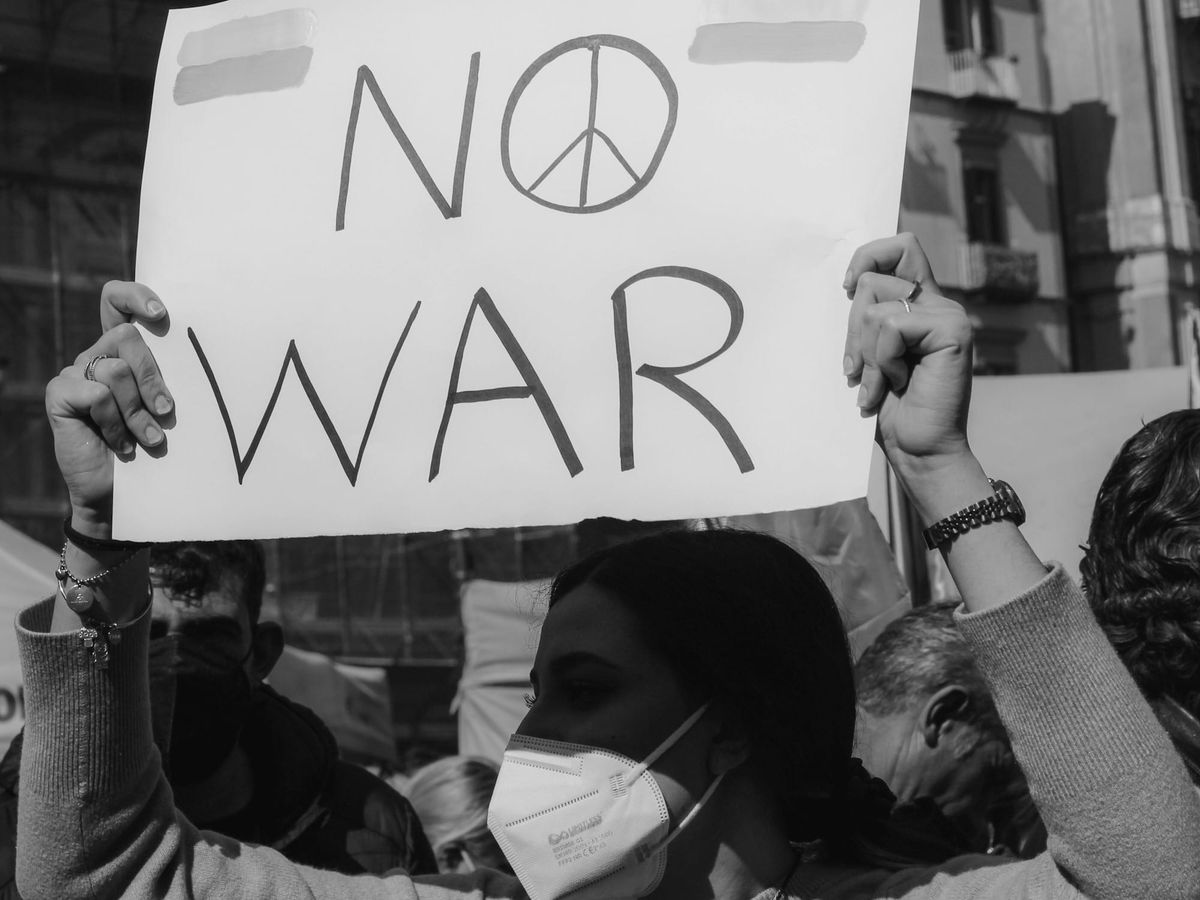
New tensions in the postwar arrangements between the US and Europe, the transformation of the Cold War détente into new inter-imperial rivalries, and the current proposed downsizing of the European welfare state — a social advance which had been permitted by the Marshall Plan when system competition required it and the postwar boom and strong Fordist labour movements enabled it — are now plain for all to see; and they are occurring against a backdrop of the chronic underinvestment resulting from capital’s inherent tendency to financialisation and dematerialised speculation. As a way out, Europe’s elites are turning to ‘military Keynesianism’ and the construction of enemies to justify their role and give the EU a new legitimacy in the eyes of popular majorities who have been alienated from it. All of this confirms the thesis that, despite all the mediations and varying conditions, capitalism at a certain stage of its development tends towards war.
At the same time, the US sources of what Nancy Fraser dubbed ‘progressive neoliberalism’, along with varieties of left radicalism exported culturally to Europe starting in the 1990s, have begun to dry up. The importance of these exports cannot be underestimated in view of the tremendous impact of US cultural imperialism. In the case of progressive neoliberalism this export occurred not as a simple one-way ‘McDonaldisation’ but rather as what Luciana Castellina calls ‘Pizza-Hut’isation’, in this case a US re-export of ideas originating in Europe (particularly in the French academy), beginning in the 1980s and 1990s involving left theory and modes of activism.
Progressive neoliberalism arose at a time of post-Fordism and the shift of the centre-left’s base from the urban working class to the suburban and urban professional-managerial class, a shift promoted by Bill Clinton as well as Tony Blair and Gerhard Schröder and supported by US social scientists and, most notably in Britain by Anthony Giddens. Its perspective was that the overarching antagonism between capital and labour was a thing of the past, while the new social reality was seen as almost post-historical, as open and pluralistic, involving a democratic, de-centralised entrepreneurialism that requires not transformation but only inclusion and participation. In that framework, difference, diversity, and anti-discrimination became more relevant than what is traditionally known as the social question — the issue of large-scale social inequality — associated as it is with class antagonism. In the US this built on the country’s ‘exceptionalism’, i.e. the particularity that labour movements there were mostly not perceived by a majority as representing the general interests of society, at least not as much as they could be in Europe.
However, aspects of the diversity paradigm have also been internalised by parts of the radical left — in the US as well as in Europe. It is crucial to understand the progressive content of progressive neoliberalism because a part of the 1968 movement in the US rejected big federal bureaucracies, trade unions, and large political organisations in general, demanding de-centralisation, flexible work lives … in a way that neoliberalism could absorb, giving it a legitimising progressive character that was essential to its vitality.
But now, in the last several years, we are seeing what most of us would agree is a welcome shift. Along with the revitalised labour mobilisations in France and Italy, the social question returned sharply in the US following the 2009 financial crisis, with the Occupy movement, the rediscovery of politics (that is, politics beyond protest) by parts of the radical left, and in the spectacularly increased popularity of the idea of unions. As strange as it may at first seem to focus on US developments at the very beginning of a volume about Europe, it is unavoidable in view of the reality of the collective imperialist system comprising the US and its European sub-imperialisms and concentric circles, and the concomitant outsized influence of US social and cultural developments.
In sum, we can see by hindsight that in both cases — the postwar division of labour in the Atlantic Alliance with strong European welfare states accepted by the US in a war-free Europe — and the neoliberal utopia of the end of the social question — we were dealing with transitory phenomena tied to historically specific conjunctures that were over-theorised as permanent. History has returned. The declared end of a labour-oriented opposition to corporate dominance and its replacement by the discourse of diversity and recognition arose in a specific moment: after the advent of post-Fordism but before the social question returned in a major way. The answer now to the turn away from labour is of course not a return to reductionist misperceptions — traditionally harboured by much of the social democratic as well as transformative labour movements — of what a worker or the working class is. Nor are we advocating a return to fatalistic and teleological conceptions of capitalist apocalypse or revolution. But we do see and welcome incipient signs of a return to the best traditions of Marxism: a holistic analysis of capitalism’s developmental ten-dencies and the dialectic of agency within it.
Nancy Fraser’s critique of liberal feminism — and of certain radical feminisms of difference — is that it takes capitalism’s hiving off of reproduction from production — a compartmentalisation that is a structural pillar of capitalism — and its construction of women as altruistic and caring, and men as their opposite, as differences inherent in the genders. Fraser’s wish to bring back critical theory’s concept of social totality makes her suspicious of a shopping-list approach that adds up and juxtaposes different kinds of oppressions before making the effort to see how they interrelate and function together to constitute the capitalist mode of life, or how they are produced by the capital-labour relation. This is why she has been uncomfortable with conventional uses of the term ‘intersectionality’, a concept she regards, however, as having been productive when first introduced as a corrective to class reductionism, the latter tendency starkly contrasting as it does to the process-oriented approaches of the best Marxist and derived traditions, including that of the Frankfurt School which Fraser has contributed to developing. She contrasts the outlooks of two different generation of feminists: the feminists of her New Left generation demanded not just inclusion or redistribution within the system but general system change, while movements emerging in the neoliberal years tended to focus on identity. Regarding divisions in the current women’s movements, Fraser strongly supports the recognition of trans rights and their inclusion in the general feminist movement but warns that if sectoral struggles over gender and identity are not connected to broader material concerns associated with ‘class’, all radical movements become susceptible to media narratives, state institutions, market forces, and general co-optation.
Nedjib Sidi Moussa in particular warns against the uncritical importation of US academic trends and problematises the negative aspect of anti-racism and anti-capitalism, etc. His view is that the only contestation of racism capa-ble of drying up its sources is one embedded in a positive vision of a desirable society — an association of free individuals — which, he indicates, takes us far beyond flimsy notions of ‘inclusion’ or ‘diversity’ which have been fully integrated into corporate jargon. He analyses the European Commission’s re-port on racism but also criticises sectarian left trends. Interestingly, he revives Micheline Labelle’s critique of ‘horizontal racism’ or ‘ethno-differentialism’. A fundamental problem of the broad public discussion, he points out, is that the US academic-generated discourse, some of which reified the notion of ‘race’, could legitimise itself because it was bound to be attacked by conservatives, ending in a triangulated debate between ‘liberals’, ‘illiberals’, and ‘radicals’, which has shut out a Marxist critique.
Sidi Moussa points to the irony that the US academic exports criticised by Bourdieu and Wacquant are now, in the last ten years, being confronted precisely by African-American left intellectuals who are criticising difference theory and black identity essentialism, etc. Yet they are virtually unknown within Europe’s radical left, something our journal intends to rectify in upcoming issues.
Ivan Tranfić, in parallel to Nancy Fraser, demonstrates that the populist radical-right ‘anti-gender’ movements in Eastern Europe cannot be reduced to cultural or identity frames (or the issue of sovereignty) but are effects of the crisis of social reproduction and contemporary capitalism’s transformation of family and gender relations. With welfare systems in Eastern Europe dismantled, familist ideology promises women protection from the fear of losing the only remaining element of a safety net for women: the family. This ideology is all the more potent that the imported gender equality mostly benefitted upwardly mobile, middle-class women and coincided with increased inequalities proclaimed to be necessary to the sacred principle of competitiveness. To many working-class Eastern Europeans, gender equality is as-sociated with increased social inequality. As Fraser has said, financialised capitalism generated an ‘alliance of marketisation and emancipation against social protection’.
We are publishing two texts — one by Floya Anthias, Ron Ayres, and Nicos Trimikliniotis and an interview with Sandro Mezzadra conducted by Olga Lafazani — by authors whose activity has unfolded in university faculties built around various discourses — marginality, diversity, intersectionality, and post-colonialism — or in close dialogue with them. However, they have become increasingly disturbed by the way these discourses have largely been emptied of their earlier class critiques.
Sandro Mezzadra and Olga Lafazani — whose academic work has been combined with intense participation in social and protest movements — lament the increasing reduction of intersectionality to identity politics as well as the loss of neoliberalism’s utopian optimism based on valorising individual skills through the concept of human capital. In agreement with Sidi Moussa, they note how Trumpism’s anti-woke crusade has stoked a renewal of identity politics as a response, and in reaction to this has provoked a whiteness identity in the US. They also argue that the left identity-politics response no longer has the productive relation it had to mainstream politics in the 1990s, which had stimulated movement-building. Above all, they point to new thinking, which Mezzadra has been instrumental in developing, around the concepts of migration and borders which offers a sharp lens through which to perceive the evolution of cotemporary societies.
Floya Anthias, Ron Ayres, and Nicos Trimikliniotis offer an analysis of the mutually determining factors of ethnicity, nation, and class in Cyprus, still under the strong impact of its colonial legacy. They situate their analysis within the structural evolution of global capital — financialisation and the centrality of ‘platform capital’, and the way in which tax oases and banking hubs are distributed in the world, requiring much migrant labour — in a country where nationalism limited the development of an inclusive class politics. They suggest that understanding the relation of ethnicity to class could help the Cypriot communists (AKEL) in developing a more integrative politics, which it has to some extent already put into practice.
Fabian Scheidler documents and analyses the astonishingly rapid militarisation of Germany’s economy and culture, a militarisation unprecedented since World War II. The new goal of 5% of GDP to be spent on the military, subsequently reduced to 3.5%, corresponds, in the case of the lower figure, to 35% of national budgets. Leading politicians and economists are now portraying the European social model as having always been unaffordable in the first place. The glorification of war and the recruiting even of minors could not have been imagined if one had predicted it just one year ago. Scheidler, like Hugo Pompougnac, demonstrates how fundamental war production is to Europe’s economies, and shows how militarisation and military Keynesianism (with a vastly reduced welfare state) are seen as the only way to compensate for Germany’s declining soft power. An additional motive for the elites' preference for military expenditures over social spending is that the latter whets people’s appetite for more self-determination and democracy. An external threat is necessary for all this, and can moreover justify various states of exception and allow much ad-hoc legislation that re-allocates funds, while helping to put aside issues of inequality or climate chaos. And with Western ideological coherence crumbling, the War State can bestow a sense of direction and unity on the governing elites.
Hugo Pompougnac points out the leading role France’s military industry plays in the EU’s trade and industrial policy. The more so that Brexit removed one of its competitors, and the war in Ukraine allowed it to expand. Trumps aggression towards the EU allowed it to become even more important. He criticises parts of the left which, convinced that Russia aims to attack Europe, support armaments as a just response to Russian imperialism, even leading some on the left to claim that that the arms industry is ‘progressive’. While condemning US excesses in the past, some now realised more explicitly how the European way of life depends on the Atlantic alliance, and so Trump’s disruption of this balance brought together pro- and anti-Atlanticists, since both now oppose Washington’s new policy. The plunge into authoritarianism in the US stoked fears that the heart of the ‘free world’ could collapse, leading a part of the left to respond: ‘we Europeans have to defend our way of life from our predatory neighbours’. War, Pompougnac emphasises, really is the continuation of politics by other means, and Macron’s imperial policies cannot be separated from his austerity at home. Just as this degree of militarism cannot be achieved without emptying out the welfare state, the ties between US and French capital cannot be broken without driving out the owners of the large corporations and challenging private property.
Paweł Wargan demonstrates how all this is occurring at the European level, pointing out the persistence of the postwar ‘collective imperialism’ that Samir Amin named the Triad, in which European sub-imperialism and European integration were elements of the continent’s subordination to the US, and which established mechanisms to extract surplus from Europe’s peripheries to its centres. Germany still understands that its dominant position within the EU remains tied to its US-subordination within the Triad — as demonstrated by its government having to swallow the loss of cheap Russian energy imports. The contradictions within the US-led system could only lead to war, Wargan stresses. His essential argument is that the EU can only survive by preserving the structures of the collective imperialist accumulation that birthed it and sustained it. The militarisation of Europe, which appears to be preparation for an unavoidable war with Russia, its impact on citizens’ living standards, as well as the dangerous rise of the far right, are critical issues to which the left must respond at both national and European levels. Starting from this observation, Cornelia Hildebrandt and Helmut Scholz explore whether such a response is possible by presenting the operational and strategic problems faced by Europe-wide political formations. Referring to the recent split of the European Left Party (EL) and the creation of a second European party, the European Left Alliance for the People and the Planet (ELA), they analyse its causes, the internal differences on various issues that stem from the divergences among the national parties that comprise them—such as, for example, the issue of creating a European army—as well as the agreements and disagreements between the two parties regarding strategic issues. They note that there is alignment of programmatic positions on almost all issues (social matters, protection of rights and the environment, etc.), with the exception of foreign policy and security, where there are serious differences in the approach to the war in Ukraine and especially its cessation, despite the fact that both parties condemn the Russian invasion. They point to the specific problems faced by the two European parties, as well as the shared structural problem of their inability to formulate a unified European strategy due to the priorities and differences among the national parties that constitute them.
Angelina Giannopoulou corrects certain rigid assumptions about the left and Christianity that led to a misperception of Pope Francis as simply a leftist who has broken with Christianity. This misunderstanding, when coming from the left, is partly due to ignorance of the Gospels. The Church has always spoken of the poor. What Francis’s enemies found provocative was his view of the poor as the consequence of an exploitative economic system and his calling upon them to become agents of history in a politicised way. But the Catholic Church, at least since its Social Doctrine originating with Pope Leo XIII in 1891, has maintained a tension between the eschatology of the Kingdom of Heaven and social analysis. In Francis, this tension led him to encourage the Christian-Marxist dialogue project, and in this connection, he also was critical to the development of the ideas and techniques of dialogue and synodality. Finally, focussing on openness and doubt, which are crucial to such a dialogue, Giannopoulou very importantly illuminates, by way of Paul Tillich, the intimate and necessary connection between faith and doubt.
Joerg Rieger demonstrates that despite America’s creed of freedom for capital there have been substantial socialist movements and substantial Christian involvement in them in the US where, in comparison to Europe, the working class never was alienated from the church. There was an intimate relationship between socialism and Christianity throughout the rich history of socialist, labour, abolitionist, and temperance movements in the 19th-century US and up to McCarthyism. This began to be rebuilt in the Civil Rights movement, in the anti-war movement, and under the influence of Latin American developments in the 1970s and 1980s. Martin Luther King openly endorsed the idea of democratic socialism. However, after the fall of the Soviet Union, identity, race, ethnicity, gender, and sexuality almost completely overshadowed class, which only survived when referring to ‘classist’ prejudice rather than structural exploitation. But with Cornel West, Joshua Bartholomew and Reverend William Barber — who in a continuation of MLK’s Poor People’s Campaign has refused to accord black poverty a higher status than white poverty — class and labour is coming back into focus.
Marking 80 years after the end of World War II, Gavin Rae discusses Poland’s changing historical self-conception as it transitioned from an East Bloc country to a component of the Western geopolitical order. In particular, gradually after 1990 the narrative about World War II shifted, notably in the direction of equating Nazism with communism. There were limits to this shift because unlike the Baltic states, for instance, where nationalist forces that collaborated with the Nazis are sometimes commemorated as independence fighters against Soviet occupation, Poland was accorded a unique treatment by the Nazis: the open goal was to eradicate the Polish nation altogether, and so there are no such nationalist groups that the far right can rehabilitate there. Nevertheless, despite this limitation, and the ongoing resentment against Germany, conservative anti-communism and the communism-Nazism equation have gained traction in the form of the ‘double-genocide’ and ‘twin totalitarian’ theories. (For extensive discussions of these theories see transform! yearbooks 2018 and 2020.) Since in Ukraine collaborators are commemorated who ethnically cleansed Poles from Eastern Galicia, and also due to economic fears regarding Ukrainian agricultural products, there are limits to the Polish population’s willingness to defend Ukraine. The historic grievance against Germany combined with the general anti-liberal populism in Eastern Europe (see Ivan Tranfić in this volume) allows the PiS to condemn the acceptance of refugees or expansion of LGBT+ rights as being imposed on Poland by the EU but especially by Germany.
Uri Weltman is a member of Standing Together (ST), the Israeli solidarity organisation of Palestinians and Jews, which has international branches. He indicates how even in an extremely adverse situation during the war, with a media that almost completely blocks out basic information and a population that largely supports its government’s colonial enterprise, an anti-imperialist organisation can manage to create small shifts that add up, neutralising the initial hostility of parts of the population, teasing out a latent counter-hegemony, to then create a majority, which can in the end be articulated. In doing so, ST was influenced by various historical examples of how public opinion could be changed by not alienating populations, including US examples during the Vietnam War, when activists ran the ‘GI coffee houses’ and organised entertainment for soldiers in Asian bases.