

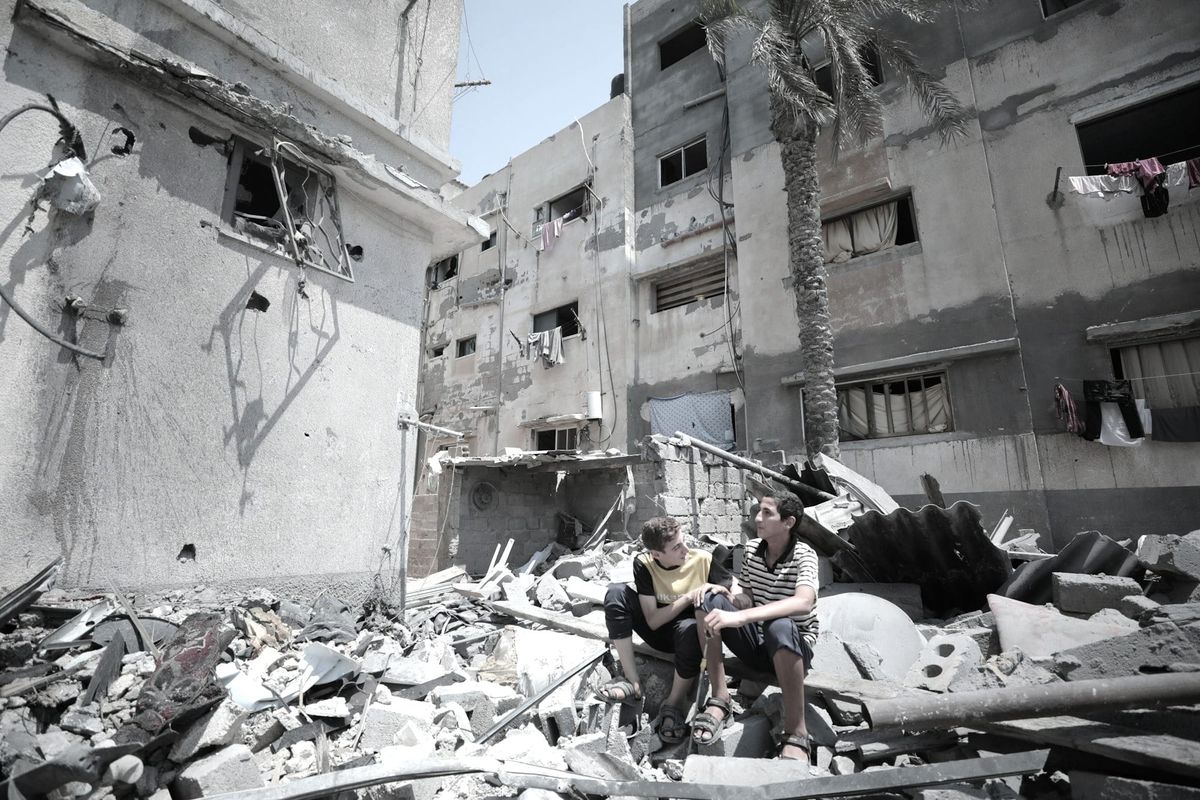
The current Gaza catastrophe has been underway for two years, with terrible atrocities committed, and with staggering destruction and loss of life. As I write these lines, the number of Palestinians killed in the Gaza Strip has exceeded 66,000, among them more than 18,000 children. Hundreds more died in the West Bank, as a result of intensified settler attacks, aided by the Israeli army. Entire towns in the Gaza Strip — such as Beit Hannoun — were erased from the map, and estimates are that around two-thirds of houses are demolished or sustained damage. Universities, schools, mosques, health clinics — the entire civilian infrastructure was made unusable by the actions of the Israeli army.
Throughout these two years of genocidal war, those parts of the left in Israel that are committed to principles of peace and internationalism, have worked on the ground, inside Israeli society, to counter the blatantly murderous path pursued by our government, to deal with rising nationalism and racism, and to present an alternative to the policies of war and ethnic cleansing.
The left in Israel faces a challenge unlike that of left-wing movements and parties elsewhere in the world. Similarly to others, we work to build public opinion in opposition to the war in Gaza and to the horrendous policies of Benjamin Netanyahu’s far-right government. However, we do so from inside Israeli society, and the people we try to convince are Israelis, many of whom voted for the parties that make up the current ruling coalition.
One of the most prominent voices inside the Israeli left in the past two year has been the grassroots political movement Standing Together1. Founded in 2015 and campaigning for peace, equality, and social and climate justice, it became a leading actor in the anti-war and peace movement in our country, having close to seven thousand duespaying members in its ranks, organised in local chapters in cities and campuses throughout Israel. Standing Together is a joint Jewish-Arab movement, grounded in socialist values, that organises both Jewish citizens of Israel as well as Palestinian citizens of Israel, and uses both Hebrew and Arabic in its activities and communications.
Standing Together’s theory of change rests on the realisation that social and political change in Israel is possible, because the majority of the people in Israeli society don’t benefit from the policies of our government, but are losing from them: ‘Israeli society’s current structure generates endless social crises. It fails to guarantee prosperity, security, or personal, social, and economic fulfilment for the majority of the population’2.
Basing ourselves on a Marxist reading of the contradictions within Israeli capitalist society, we claim that:
the current regime serves the interests of a small elite... at the expense of the majority’s interests. The current system works for the sake of a minority at the expense of the majority. However, it remains dependent on the majority’s consent. And while the majority complies, it does so with a silence stemming from despair and disbelief in alternatives – not genuine desire. Therefore, Israel’s ruling political structure is far weaker than it appears.
This is the starting point of our work. We campaign against the structural discrimination and deep inequality of the Arab-Palestinian minority within Israel, and against the decades long military Occupation by Israel of the Palestinian Territories, working to mobilise Israeli citizens out of their own self-interest in pursuit of an entirely different policy than that of the political establishment of our country.
We are not content with simply voicing criticism for the sake of criticism, nor do we plan to go down in history as a footnote that reads that ‘even in dark times there were few voices that ineffectively called out against what was happening’. We organise in order to effect change, trying to make a political impact on the course of events. In this article, I will walk through the stages of the past two years, and review our work as we tried to shift public opinion, convince the unconvinced, and build power.
Drawing on examples from movements abroad
In our work inside Israeli society we stand on the principle championed by the left throughout its history, that the people are distinguishable from their rulers, and that the society can be understood to stand apart from its government. In this respect, we are inspired by the example of peace and progressive movements that came before us, in various countries, that struggled to convince and mobilise their respective societies against the wars waged by their governments. This was the case, for example, in the fight championed by the left in the United Kingdom in the early 2000s, when the British government, under Tony Blair, joined the war drive of US President Bush in Afghanistan (2001) and Iraq (2003). The UK left — through such formations as Stop the War Coalition (STWC), the Campaign for Nuclear Disarmament (CND), and efforts by the
We are not content with simply voicing criticism, nor do we plan to go down in history as a footnote that reads that ‘even in dark times there were few voices that ineffectively called out against what was happening’. We organise in order to effect change.
trade unions and the left-wing of the Labour Party — has worked to sway public opinion away from supporting these wars. They were consistent in both highlighting the human suffering of the Iraqis and Afghans, as well as the cost that working people in Britain had to pay, through austerity measures and budget cuts, to fund an expensive war abroad.
Despite the fact that the war crimes committed in Iraq and Afghanistan were public knowledge, Blair’s Labour government was re-elected in the 2005 general election. Following that, the British left has resisted the temptation to denounce its own society as morally corrupt, or to give up on convincing workers, students and youth about the need to change course, and has redoubled its efforts to agitate, propagandise, and meet people where they are. The fact that eventually British troops were withdrawn, is a vindication of their strategy. A similar trajectory was pursued in the United States, in the 1960s and 1970s, in the anti-war movement that called to pull US troops out of Vietnam. Through pickets, sit-ins, and mass marches, including allying with US Army veterans (GIs, as they were known) who changed position and came out against the government, the movement against the Vietnam war worked to grow the number of Americans who viewed with disfavour the continuation of the war, and aligned themselves behind such movement slogans as ‘Support Our GIs, Bring Them Home Now!’ Rather than declaring the American people to be the problem, the anti-war movement looked upon it as the political subject that needed to be engaged with and won over. After years of protest and organising, their efforts helped deal a blow to imperialist war plans and forced the US administration to backtrack on its direct military involvement in South-East Asia.
In the Israeli left, movements such as Standing Together see themselves as pursuing a similar course to that of the left within other countries where the governments were engaged in disastrous and unjust wars of aggression. We learn the lessons of these successful campaigns, while adapting to local conditions, constraints and societal particularities.
In the period following the October 7th attack
The Hamas attack on towns and villages near the Gaza border, on 7 October 2023, claimed the lives of more than 1,100 Israelis, most of them civilians. 251 hostages were taken into captivity in the Gaza Strip, 39 of which were children, the youngest being a ten-month-old baby.
The surprise attack threw Israeli society into shock and anger. The government used the state of fear to prop up nationalist sentiments, and rallied strong public support behind its plans for retaliation, targeting as enemies not Hamas militants but the entirety of the population in the Gaza Strip.
When the then Minister of Defence Yoav Gallant justified the cutting of electricity and water to the civilian population in Gaza, which is an act of collective punishment that goes against international law, he said ‘We are dealing with human animals, and we shall deal with them accordingly’3. The Minister of Energy and Infrastructure at the time, Israel Katz, who is currently the Minister of Defence, said ‘All the civilian population in Gaza is ordered to leave immediately. We will win. They will not receive a drop of water or a single battery until they leave the world’4.
In January 2024, the International Court of Justice (ICJ) cited these statements5 that sought to dehumanise Palestinians and called for their collective punishment, as plausible evidence of the Israeli government’s genocidal intent towards the Palestinian people.
The European Left Party responded swiftly to these developments, and in a statement on 12 October 2023 urged ‘an immediate cessation of violence in Israel and in the Palestinian territories. The indiscriminate targeting of civilian populations violates international law. This applies to the massacres operated by Hamas or Islamic Jihad, but also to the bombardments of residential buildings by the Israeli Army’6. It further stated that while Netanyahu’s far-right government has for months stepped up its violence towards the Palestinians, this cannot justify the attacks, assassinations and kidnappings carried out by Hamas against the Israeli civilian population, which constitute war crimes that we condemn unreservedly. Just as the bombings and other retaliation by Israel against all Palestinians in Gaza, mostly civilian, constitute war crimes. We oppose attempts to punish the whole Palestinian population for the attack by Hamas on Israel.
During the afternoon hours of October 7th — while sirens were still ringing in Tel Aviv, directing people to take shelter as rockets were being fired from Gaza, and everyone was glued to their phones, watching the news, trying to grapple with the uncertainty of what is happening and what will happen next — Standing Together put out a statement saying that:
what we saw today was a result of the government’s insistence to lead us all into a dead end, without any promise for a better future. We saw today a terrible and painful proof that there is no way to ‘manage’ the Occupation, while ensuring our security. No matter how many fortifications we will build, as long as the policy in place is a policy of war — we will continue to pay in blood. And it is unimaginable how much innocent blood, of Israelis and Palestinians, was shed today.
And further it read:
It is hard to write down these words now. It seems far off, but there is no choice but to say: without changing course — we are destined to continue and relive today’s horrors. In our land there are two peoples, and if we deny any one of them freedom and independence, we can never rest peacefully. We don’t delude ourselves that it will be easy or done quickly. But we know and remember: only true peace can guarantee us the security we all so badly need right now. War, even when the blood boils, will not bring us what we need.
On the very day of the October 7th Hamas attack, far-right bigots in shared Jewish-Arab cities inside Israel (such as Haifa, Jaffa, Akka, etc.) started to call for revenge, spouting hatred and portraying all Arab-Palestinian citizens of Israel as ‘traitors from within’, saying now is the time to ‘finally deal with them’. We responded the very next day by launching a country-wide initiative to organise local grassroot groups of Jewish and Arab-Palestinian neighbours — who
International media paid attention to the sight of Jews in Israel packing a mosque amid a war; to hear speeches for peace was indeed an unusual sight.
live in nearby neighbourhoods within the same city, or in nearby towns — in order to assemble a counterweight to this racist threat of inter-communal violence, the likes of which we saw in May 2021. Dozens of local groups sprang up, some based on our already existing local organising efforts and others in places where we weren’t present before. These local solidarity groups worked to organise Jewish and Palestinian citizens of Israel in community efforts to deescalate tensions and isolate calls for violence, to put out in Hebrew and Arabic a message of a shared and equal future, and to promote Israeli-Palestinian peace as an alternative to war and occupation.
Another important aspect of our work at that time, was working to counter the targeting and the demonisation of those Arab-Palestinian citizens of Israel who dared to express criticism towards the war. Palestinian students in Israeli universities and colleges who posted messages on social media saying killing innocent children in Gaza is wrong — were charged with ‘supporting Hamas terrorism’ and threatened with expulsion from their institute of higher education. Palestinian citizens of Israel who worked in various shared work-places, like hospitals and academia, were sometimes threatened with disciplinary action, perhaps even being fired, for expressing views against the war. A McCarthyite-style witch-hunt ensued, that our local Jewish-Arab solidarity efforts had to address.
This national network of local bi-national solidarity groups7 came into being, because we as a movement constantly ask ourselves ‘Under what conditions do we operate? What is the task at hand?’ In the days and weeks following October 7th, facing police repression and worrying about the danger of inter-communal violence, the task that we set for ourselves was dealing directly with that. At the time, this was the central space existing within Israeli society to raise criticism towards our openly fascist government ministers, their genocidal statements, and their ruthless massacre of Gazan civilians.
Our government was bent on trying to incite violence against the Palestinian citizens of Israel, especially in the so-called ‘Mixed Cities’. But unlike in May 2021 when it was successful, this time around it didn’t happen, in part because of our efforts on the ground that created antidotes to such attempts. Yet, our efforts also met obstacles. The police were unwilling to issue permits for demonstrations, so we had to find ways to circumvent this. Therefore, in November-December 2023 we organised a series of mass indoor Jewish-Arab rallies, in more than a dozen cities in Israel, including Tel-Aviv, Jerusalem, Abu Gosh, Baqa al-Gharbyyiah, and others. Hundreds attended each of these events to hear speeches by Jewish and Arab-Palestinian leaders of Standing Together in support of peace, ending the Occupation, and stopping the racist witch-hunt of Palestinian citizens of Israel.
The biggest of such rallies was held in Haifa, which was attended by around 700 people. Extreme right-wing activists pressured an event hall to prevent us from holding our rally there, so we went to the mosque in the Kababir neighbourhood. Personally, it was my first time organising a political event inside a mosque. Hundreds of Jewish and Arab-Palestinian residents of Haifa came to the rally. After the 300 seats in the main prayer hall of the mosque were filled, more than 200 sat on the floor or stood in the aisles, until eventually there was no longer any room in the main hall. This meant that more than 150 people had to pack a nearby room, where the speeches were screened via video. International media paid attention to the sight of Jews in Israel packing a mosque amid a war; to hear speeches for peace was indeed an unusual sight8.
Mobilising openly against the war
In December 2023, after weeks of being denied a police permit to organise an anti-war demonstration, we decided to go ahead without such a permit. This wasn’t a decision we took lightly. Our Minister of National Security, Itamar Ben Gvir, holds openly fascist views, and would not have hesitated to escalate police repression against us. But our strategic thinking rested on two considerations: First, it is dangerous to accept a ban on demonstrations, even as a supposedly temporary measure. History teaches us that when repressive governments take an authoritarian turn, they often curtail civil liberties under the guise of ‘emergency measures’, calling this ‘temporary’ but in fact using the extraordinary circumstances as an excuse to drive back civil rights permanently. Secondly, we wanted to create a space for us to make our anti-war message heard in the public sphere, out in the streets, as a way to move the struggle a step forward, towards the next stage.
And so, we embarked on an unauthorised protest. Hundreds gathered in downtown Haifa, including bereaved families that lost loved ones in the Hamas attack on October 7th, demanding a ceasefire agreement. Seeing that police didn’t attempt to repress this protest, thousands rallied and marched in the following weeks in Tel-Aviv calling for an end to the war, in demonstrations that were finally issued police permits, albeit following stalling and harassment, forcing us to threaten the police with legal action.
Thus began a new stage in the development of the opposition to the Gaza War inside Israeli society, in which we were able to openly mobilise in the streets. This included both anti-war demonstrations organised by ourselves, but also intervention inside the mass anti-government protests that started to emerge. These mass protests, which were opposed to Netanyahu, were centred on demands for releasing the hostages and for early elections to be held. They were led by a diverse coalition of forces, mostly hailing from the liberal centre. Every Saturday they organised a series of country wide demonstrations, in a wave of protests that at its height drew crowds of hundreds of thousands out into the streets. These protests were joined by the families of the hostages, who announced in March 2024 that they saw Netanyahu’s government as an obstacle on the way to reach a deal on hostages, and that toppling his government was the only way to achieve a ceasefire agreement that would bring their family members back home. We in Standing Together intervened in these weekly mass protests, supporting their just demand for a ceasefire agreement to release the hostages, adding to that our messages, in Hebrew and Arabic, that also highlighted the terrible crimes being committed against innocent civilians in Gaza. Our ‘Purple Blocs’ — the contingents of Standing Together members and supporters, wearing our purple T-shirts and handing out bilingual purple signs — became a fixture of the weekly anti-government, pro-ceasefire protests across the country.
Through consistent participation in these actions, being in dialogue with other protesters, patiently explaining our positions and defending them in arguments, we’ve increased both the size of our Purple Blocs, as well as their geographic spread across various cities. This was a strategic decision: not to be content with just organising our own anti-war demonstrations, attended by thousands of left-wing activists, but also to complement this work by engaging with the masses of liberal-centrist protesters, with whom we shared the common demand for a ceasefire, trying to influence their perspectives and slogans. A challenge we faced throughout most of 2024, was that the mainstream media, with a handful of exceptions, was unwilling to give coverage to the peace movement and to open calls for ending the war. While the mass protests for releasing the hostages were lauded in the press, those voices within these protests that also spoke against the war crimes in Gaza — were rarely heard. This forced us to look for opportunities to ‘break the media siege’. And as the far right continued to assert itself on the ground, these opportunities presented themselves.
The Solidarity Guard — confronting settler violence
In May 2024, shocking videos emerged of far-right, violent thugs that were attacking the humanitarian aid trucks. Those trucks came in from Jordan, through the West Bank, en route to the Gaza Strip, carrying food supplies for the besieged Palestinians. The violent thugs — who were mostly based in the West Bank settlements — were blocking the trucks, destroying the food, setting the trucks on fire, and beating the Palestinian drivers, all while the Israeli police stood idly by and did nothing to stop the violence. Most of these attacks took place at Tarqumiah checkpoint, which is the main checkpoint that connects Israel and the southern part of the Occupied West Bank.
In response, we in Standing Together launched what we called ‘The Humanitarian Guard’ (now renamed the Solidarity Guard), which is an initiative aimed at bringing activists from Israel to Tarqumiah checkpoint, in order to confront the settlers, document their violence, come between them and the trucks to defend them, and to demand that the police who were present prevent the attacks from taking place.
More than nine hundred Israelis signed up to take part, with dozens coming in daily shifts, sporting purple vests and armed with cameras, often outnumbering the far-right offenders. After several weeks of daily presence, in which we helped aid trucks to pass unhindered, the extremist groups that terrorised the trucks announced they ‘temporarily’ suspended their activities. We celebrated it as a win for grassroots mobilisation, and a show of strength for the ability of the Israeli left to deal a blow on the ground to the violence of the far right.
That was not the last time we mobilised the Solidarity Guard. Every year, in the annual commemoration of the military occupation of East Jerusalem in the 1967 war, the far right organises its ‘March of Flags’ in the Old City of Jerusalem, where tens of thousands of young people — mostly from the settlements in the Occupied West Bank — march, chant racist slogans, vandalise Palestinian owned stores, and violently attack passers-by.
This year our Solidarity Guard was there, with dozens of activists trained in nonviolent protective presence patrolling the streets and alleys of the Old City, working to de-escalate and to physically put their bodies between the racist hooligans and the Palestinian residents.
These actions drew attention to the ease with which far-right attackers use violence with impunity. They also received coverage in the mainstream media, as liberal public opinion in Israel is often antagonistic to West Bank settlers. In this manner, even groups and individuals who hold different views than our own, in regard to the war on Gaza, were sympathetic to the actions of our Solidarity Guard, sharing it on social media and writing about it in the press. This helped open up a space for us to present our views, and to start to break the ‘media siege’ on the anti-war movement.
Partnering with people different than ourselves
In order to grow the opposition to the continued slaughter in Gaza, it is not enough to work with the early existing peace movement. When public figures from the establishment come to anti-war positions and are willing to call for a ceasefire, it is strategic to amplify these voices, so that they can help convince others. We see this as one of our responsibilities.
In 2024, on the eve of the International Day of Solidarity with the Palestinian People (29 November), we initiated an anti-war march in Tel-Aviv, that stood out from the previous ones we organised because among the speakers at the rally were some very mainstream and institutional public figures, for whom appearing on stage in a rally organised by Standing Together was something out-of-the-ordinary.
Among them: Retired Major General Amiram Levin, former Commander of the Israeli army’s Northern Command, as well as former Deputy Head of the Mossad; Eran Etzion, a retired veteran diplomat, former Deputy Chair of the National Security Council and former head of the Department of Diplomatic Planning in the Ministry of Foreign Affairs; Orna Banai, a very well-known TV actress and comedian; Dr. Tomer Persico, a columnist in Haaretz newspaper and a lecturer in Jewish Philosophy; Chen Avigdori, whose wife and daughter were taken hostage by Hamas on October 7th, and were released in the first temporary ceasefire and hostage deal. Also speaking were Ghadir Hani, a Palestinian leader of Standing Together, and Somaya Bashir, a Palestinian leader of Women Wage Peace.
Because we see our role not merely as mobilising the already existing ‘peaceniks’, but also swelling the ranks of the anti-war movement, it was important for us to give a platform for speakers with whom we don’t necessarily agree, or who employ language that at times diverges greatly from our own, but who, owing to their background and past titles, can help shift the public conversation and win people over to views close to our own. This kind of engagement with us can also help shape the political behaviour of these left-moving establishment figures. Retired Major General Amiram Levin, for example, who spoke at our protest, now openly calls the actions of the Israeli army in Gaza ‘a genocide’9.
This kind of work was impactful. As the year 2024 drew to a close, it became clear that Standing Together — along with others — succeeded in linking together the call for releasing the hostages, which was popular and enjoyed a consensus support, to the demand to end the war in Gaza, which in the beginning of the year was considered beyond the pale, and even treacherous. Polling suggested that by the end of that year, 71% of Israelis supported ending the war and reaching a hostage deal. Even among voters of Netanyahu-aligned parties, such an agreement was supported by 56%. Thus, Netanyahu’s government was — and still is — on a collision-course with the will of the majority of Israelis.
Non-violent direct actions, acts of disruption and reservist refusal
The year 2025 began with a ceasefire agreement reached between Israel and Hamas. It included Israel stopping the daily bombing of civilians in Gaza, with humanitarian aid finally allowed to enter, Palestinian prisoners re-united with their families after being illegally held in Israeli jails, and hostages released from Hamas captivity. This did not last long, since in mid-March Netanyahu decided to collapse the ceasefire agreement and resume attacks on Gaza, in order to maintain the support of his far-right coalition partners, who threatened to topple his government.
Anger grew, as the majority of Israelis saw through Netanyahu’s lies, realising he resumed the war solely for his own political interests, in order to survive
Liberal public opinion in Israel is often antagonistic to West Bank settlers. Even groups and individuals who hold different views than our own in regard to the war on Gaza were sympathetic to the actions of our Solidarity Guard. This helped open us to start to break the ‘media siege’ on the anti-war movement.
in power. Public-opinion polls conducted at the time showed that the majority of Israelis wish to punish the parties that comprise the ruling coalition in Israel. The Netanyahu-aligned parties are set to lose their majority in the Knesset (parliament) with polling in September 2025 showing that they are set to win merely 47 to 49 seats out of the total 120, were new elections held today.
By spring, the government was increasing its military manoeuvring in Gaza, openly speaking about forcefully displacing civilians and evacuating entire cities in order to turn them inhabitable. The politicians in power have been openly expressing their willingness to enact a genocide, in order to realise their dream of unchallenged Apartheid, something that many people were no longer willing to stomach.
In May, we carried out a massive non-violent act of civil disobedience, in which hundreds responded to the call of Standing Together and arrived at the Gaza Border, in order to physically block the roads that the army used to transport tanks and soldiers into the Gaza Strip. The activists were met with the violence of the Border Police, and Alon-Lee Green — our National Co-Director — was one of nine protesters arrested during the action, and held in custody for several days.
Responding to the growing starvation in Gaza, with international humanitarian agencies sounding the alarm about the catastrophe that is unfolding, and with daily news of Palestinians suffering from malnutrition, including children dying of hunger — we organised the Flour March in Tel-Aviv. Hundreds of protesters marched carrying bags of flour, to highlight the growing crisis of starvation in Gaza, enacted by our government.
The Flour March — which was widely covered in the press and went viral on social media — served as a catalyst for us and others to launch dozens of vigils in Arab-Palestinian towns and villages inside Israel. There, people were breaking the barrier of fear, and after almost two years of silencing and repression, were willing to turn up for protests, holding pictures of starving Gazan children, and banging empty pots and bans to protest against the deliberate starvation of civilians. This was not the first time we organised around the issue of hunger in Gaza, having launched months before the People’s Campaign Against the Starvation of Gaza, in which we called for people in Israel — especially in the Arab-Palestinian community — to donate food supplies to be delivered to Gaza. Close to 400 trucks full of food were collected, with most safely making their way into Gaza, albeit with others facing difficulties from the Israeli government, and rerouted into the West Bank.
At this time, we determined that the vast majority of Israelis are already against the war in Gaza, and what is needed is not to convince supporters of the war to become opposed to it. What is needed is to create conditions on the ground that would help the majority exert its power over the government, to make continuing the war more difficult, through a two-fold plan of action: first of all, we want to create acts of disruption that would make business-as-usual an impossibility; Secondly, we want to encourage more and more reservist soldiers to refuse to turn up for duty, in order to deny the army of the manpower it needs to carry out the orders of the cabinet.
We put out a call for people to volunteer for various acts of disruption: from people volunteering to drive around their cars in major cities, playing messages through megaphones about the horrors of the war in Gaza, to people taking non-violent direct action that focused public attention on the crisis at hand. Standing Together activists burst onto the set of Israel’s version of the reality TV show Big Brother, chanting messages against war and starvation;10 also burst into the studio of the current affairs talk-show The Patriots, on the right-wing Channel 14; held a protest inside Ben Gurion international airport, and spilt red paint outside the home of the army Chief of Staff, protesting against ‘the rivers of blood’ that flow in Gaza.
We worked alongside army reservists who were willing to come out openly against the war, saying that if they are called for duty in Gaza they would refuse to serve. We gave public backing to those former soldiers, amplified their voices as they used their ex-army status to express criticism towards the government, and joined forces with groups of veterans in calling on soldiers to refuse the blatantly illegal order to occupy Gaza City and forcefully expel its residents.
The role of international pressure and the path ahead
The international recognition of the State of Palestine in the UN General Assembly in September — reinforced by countries such as the UK, Canada, France, and others — dealt a blow to Netanyahu’s government, which is determined to take the idea of Palestinian statehood off the table.
As the international movement for solidarity with the Palestinian people continues to mobilise in the streets and to influence the political discourse in many countries, more and more governments are feeling forced to ban weapons sales to Israel or to announce sanctions on violent West Bank settlers and Israeli government ministers.
These important developments continue to inform the realities of the Middle East, which for the past two years saw the Israeli government attack not only in the Occupied Palestinian Territories, but also in Lebanon, Syria, Yemen, Iran, and Qatar.
They also shaped the context which forced Netanyahu’s hand, leading to the ceasefire agreement reached in Sharm El Sheikh, which came into effect on 10 October 2025. This agreement, imperfect as it maybe, has nonetheless brought millions of Palestinians and Israelis a much desired breath of air. At the time of writing, the daily bombing of Gaza have been stopped, humanitarian aid allowed to enter, close to 2,000 Palestinians released from Israeli jails, and all the Israeli hostages still alive have been freed from Hamas captivity and reunited with their families. But we must not take Donald Trump’s rhetoric at face value: a ceasefire agreement is very different from a peace agreement, and much more is needed. While ending the horror in Gaza is the most urgent task, there cannot be and won’t be a return to the prewar status quo.
The only way to guarantee a life of safety and security for both Israelis and Palestinians, is through a diplomatic agreement. The framework for such an Israeli-Palestinian peace remains clear: The establishment of an independent Palestinian state, alongside the State of Israel, with East Jerusalem as its capital, and with the 4 June 1967 borders (‘The Green Line’) as the internationally recognised border of peace; the evacuation of all Israeli settlements in the Occupied Palestinian Territories and the dismantling of the Separation Wall; the release of all Palestinian prisoners held in Israeli jails; a just and agreed upon solution of the problem of Palestinian refugees according to all relevant UN resolutions. In our land there are millions of Arab-Palestinians, none of whom are going anywhere. And there are also millions of Jewish-Israelis, none of whom are going anywhere. Therefore, what is needed is to achieve a peace that would recognise the rights of both people to freedom, justice, and independence within our shared homeland. The left in Israel and abroad, as it fights for maintaining the ceasefire in Gaza, must not lose sight of this longerterm vision.
Notes
1 https://www.haaretz.com/israel-news/2024-01-05/ty-article-maga-zine/.highlight/a-jewish-arab-partnership-is-building-a-young-new-peace-camp-in-israel/0000018c-daa9-d751-ad8d-ffadd6e00000.
2 https://www.standing-together.org/en/about-en.
3 https://www.aljazeera.com/video/newsfeed/2023/10/9/israeli-de-fence-minister-orders-complete-siege-on-gaza.
4 https://x.com/Israel_katz/status/1712876230762967222.
5 https://www.icj-cij.org/node/203447.
6 https://www.european-left.org/for-a-just-and-lasting-peace-be-tween-israelis-and-palestinians/.
7 https://www.theguardian.com/world/2023/oct/15/examples-jew-ish-arab-solidarity-offer-hope-israel.
8 https://www.facebook.com/uri.weltmann/videos/910825423804785/.
9 https://www.youtube.com/shorts/AsqH27CylLQ.
10 https://www.aljazeera.com/video/newsfeed/2025/8/10/antiwar-ac-tivists-storm-big-brother-stage-to-disrupt-broadcast-in-israel.