

No leftists’ tears should be shed over the fall of Sir Keir Starmer’s government. Within only two years of winning the 2024 general election (with merely 34 percent of the vote and 3 million fewer votes than Jeremy Corbyn had attained in 2017), Starmer achieved what many probably thought would be impossible from a Labour leader: to deliver an even more right-wing, Blairite government than Tony Blair himself. This sharp turn to the right unfolded in every major policy area: total failure to address the living cost crisis and growing inequality; Tory-like cuts to welfare (rolled back only after massive internal backlash); ongoing assistance to Israel’s genocide in Gaza and near-total subservience towards the US hegemon; repressive legislation curbing the right to protest; entrenchment of ‘public-private partnerships’, including state contracts with arch-villain companies like Palantir; reactionary rhetoric and policies on immigration in a climate of recurrent racist riots and pogroms across the UK.
No stone was left unturned by Starmer’s aim to purge any remnants of social democracy from the Labour Party. In a charitable interpretation, this stemmed from the misguided strategic choice to undercut the rapid rise of the ‘populist’ far right in Britain by adopting its agenda. As the saying goes, though, people prefer the original to the copy. Systematic evidence from across Europe shows that when mainstream parties cosplay as the reactionary right, only the reactionary right benefits from it as its agenda becomes more normalised. That’s what happened to Starmer’s Labour too: despite his best efforts to channel Enoch Powell’s racist rhetoric to chase the anti-immigration vote, recent evidence shows it has failed to boost support for Labour and affected Starmer’s approval rates. If anything, it benefited the far-right Reform UK, by mainstreaming its anti-immigration agenda.
The strategic blunder to chase Reform voters that way was all the more inept given there’s barely anyone to chase after: only 5 percent of those who voted Labour in 2024 voted for Reform in the local elections earlier this year. The overwhelming majority of voters who have deserted Labour have in fact done it for more progressive parties (Greens, Plaid Cymru, Scottish National Party) or have not voted at all. And the main reasons for that are down to Labour’s shift to the right. Even among the tiny minority of voters switching from Labour to Reform, the top reason (48 percent) was Labour’s broken promises and U-turns, particularly on tackling the cost-of-living crisis.
Starmer’s Chancellor, Rachel Reeves – who worked for a decade in the banking sector before entering politics – set highly restrictive fiscal rules that precluded the levels of public spending required to alleviate living standards and improve public services. All the while, any measure of wealth distribution was rejected from the outset, in one of the most unequal countries among advanced economies, second only to the US within the G7; when compared to the EU member states, only Lithuania and Latvia have a worse Gini coefficient. Or take child poverty, where Britain ranks 37th out of the 39 nations from across the European Union and OECD. While these problems have largely been inherited from fourteen years of Conservative rule, the Labour government did next to nothing to address them. Even their much-celebrated Employment Rights Act has been aptly described as “a reversion to a New Labour model that prioritises individual rights over collective power”.
While there were no high expectations to start with, within two years the Starmer government managed to bring Labour to an all-time low of 16 percent in the polls, on par with the surging Greens from the left and 12 points behind Reform. Unsurprisingly, the local elections in May were dire for Labour, losing control of over half of the councils it was defending, including in historical strongholds like Birmingham, Sunderland or Hackney in east London. In such a context, Andy Burnham’s rapid transition from mayor of Greater Manchester to prime minister of Great Britain within the space of a month appears less baffling.
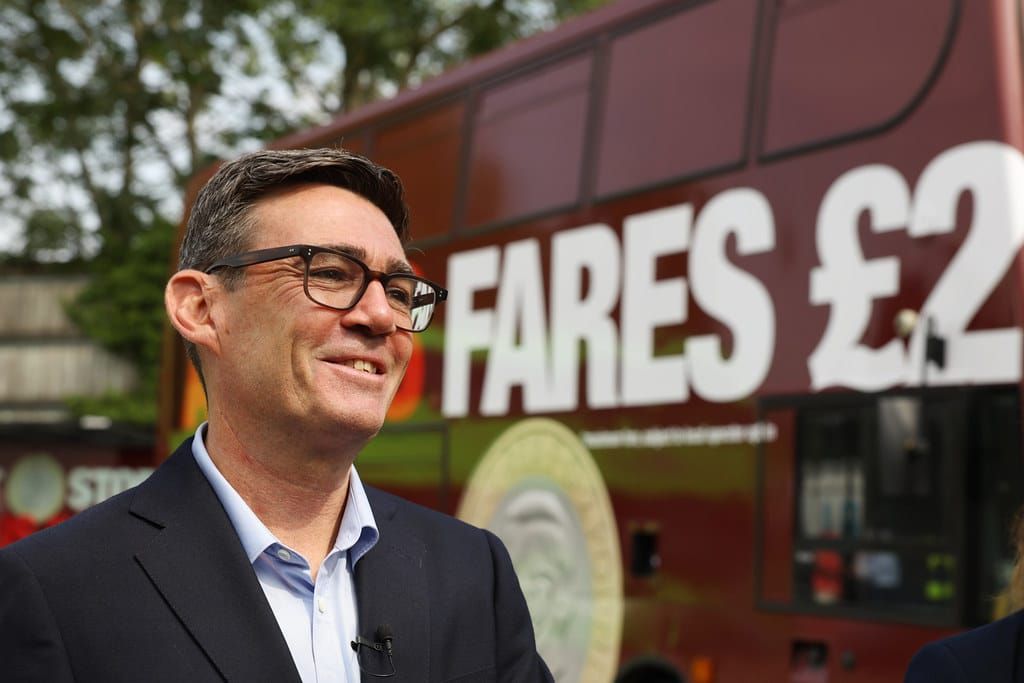
Burnham’s pitch for power signalled a sharp shift to the left. He pledged to break with the last four decades of neoliberalism by extending his model of local governance, dubbed ‘Manchesterism’, to the entire country. That would entail, for one, public ownership over key public services, as he did with the bus services when he was mayor of Greater Manchester. It would also mean a decentralisation of political power away from London, with the first step being to set up a prime-minister office for the North of the country, located (where else?) in Manchester. In his first days as prime minister, Burnham was keen to show he is ready for business, announcing several measures aimed at alleviating the living cost crisis, such as removing the 5 percent VAT on domestic electricity bills and capping the bus fare back down to £2 across England.
While they feel like a breath of fresh air compared to Starmer’s propensity for austerity, these measures will have, though, a meagre impact on people’s living standards: the energy bill cut will barely save an annual average of £45 per household and the £2 bus fare was also introduced by the Conservative government between 2023 and 2024. If Burnham is serious about parting ways with Thatcherism, he needs to complete much bigger labours than such tokenistic gestures. He needs to break the sway of financial markets over government policy. He needs to counter the rise of the far right rather than emulate it. He needs to tackle the increasing climate emergency. And he needs to address the country’s utter dependency on US hegemony. So far, there are no promising signs on any of these fronts.
To start with, Burnham’s choice of Chancellor (Britain’s equivalent of the finance minister), John Healey, represents more continuity than break with fiscal orthodoxy. In fact, Burnham has already announced his commitment to maintain the fiscal rules. As everyone knows, this is to appease the financial markets. But any political project serious about challenging neoliberal hegemony needs to start by demystifying "the markets" as the unquestionable masters of the country’s economy. The democratically elected government should be in charge of that. Markets are not some implacable force of nature that we need to work our way around. Ultimately, they’re a handful of people, with various degrees of coordination between them. We used to call them bankers. And what bankers care about is not the country’s general prosperity or people’s living standards but making rich people even richer. So why should the fate of a country’s economy be left in their hands? And why should we just go along with it? It’s a question of basic democracy that Burnham should be tackling head-on and yet he doesn’t.
Nor does he seem to tackle the other major issues. He seems fully on board with the US-driven militarisation craze, having committed to the NATO target of raising core defence spending to 3.5 percent of GDP by 2035. After all, Healey previously resigned as Starmer’s Minister of Defence because of the lack of commitment to reaching that spending target. The new Minister of Defence, Wes Streeting, has solemnly declared that the ‘Burnham government will prioritise military over other spending’. In fact, none of the key positions in this new government comes from the party’s left tendency that has survived Starmer’s repeated purges. Instead, we see people like James Purnell, an arch-Blairite and pro-Israel corporate lobbyist, being appointed Chief of Staff, while Lord Jim O’Neill, former Goldman Sachs executive, has been reportedly advising Burnham on economic matters.
On the question of climate, as the country is facing one of the driest periods on record, Burnham is considering the acceleration of drilling for oil and gas in the North Sea, in the name of ‘energy security’. But the data shows that this would not only be incompatible with climate targets but would not significantly reduce energy bills for ordinary households either. On immigration too, it’s more of the same winking at anti-immigration narratives, with Burnham pledging, in worryingly familiar language, to be ‘relentless’ in curbing small boat crossings and ‘bringing back control’ over borders. To top it off, Burnham has just backtracked on his electoral campaign pledge to allocate the government’s housing fund to building social homes only. All in all, the pessimism of the intellect would suggest that Burnham is probably cut from the same cloth as the previous Blairites in charge of Labour, but with more tactical acumen and better marketing. Expect more Justin Trudeau than Pedro Sánchez.
However, the crisis of the British left looms larger than who leads the Labour Party. Even if Burnham would be as left-wing as his most ardent supporters hope he is, to think that one man alone can transform the Labour Party back into a vehicle for working-class representation – when a leader much further to his left like Corbyn spectacularly failed to do so – is based on a misreading of what political parties are and how they work. Everything has changed about the Labour Party in these last few decades of neoliberal hegemony: not just its discourse and policy agenda, but its very own party elites, its cadre, its donors, and its voter base. Sociologically speaking, it has been an almost complete metamorphosis: from a (bourgeois) workers’ party into a party of the professional managerial class – the main class, at least in Britain, to compete with big capital (largely represented by the Tories and partly now Reform) for the helm of the state. In light of this, Burnham’s ongoing commitment to neoliberal fiscal rules or the appointment of unreformed Blairites in key positions are not mere tactical considerations to appeal to some mythical centre ground, but reflect the very nature of what Labour has become. Perhaps a Burnham premiership is the missing piece of the puzzle for everyone to finally figure that out.
What next for the British left then? Following the caricatural debacle of Your Party, the Greens are now in the best position to take on the mantle for building a new mass party of the popular classes. But to do so, they need to move beyond clever communication strategy and winning seats in office. They need to start building social linkage and grassroots campaigning on the most pressing socioeconomic issues of the day. The ‘populist’ strategy of the 2010s, centred around charismatic leadership, media savviness and electoralism, will not suffice. The left needs to be more popular than populist.