

It is not easy to take stock of France’s local elections this March.
First of all, because in France, local elections take place simultaneously everywhere, every six years. This year, they were held in about 35,000 municipalities at the same time.
Second, because in 68 percent of these municipalities (23,700) only one list was running. The rest had varying combinations of lists, whether the single candidates or alliances of left-wing, centrist or right-wing parties. In many cases, there were ‘miscellaneous’ or ‘citizens’ lists’ whose candidates were not clearly affiliated to any of the main forces.
Third, because once the votes were in, everyone seemed to claim victory.
And finally, because French local elections are rooted in specific regional dynamics, and respond to varying key issues. This makes it difficult to take the results and apply them across the board to an analysis of the national picture.
At first glance, it may appear that, generally speaking, the right-wing bloc won the elections. Taking into account the 3,290 municipalities whose winning electoral lists were assigned a political colour by prefectures, the right-wing bloc won 1,244 of them, accounting for 18 million inhabitants. The left-wing bloc, which includes the Socialists, Greens and Communists, got 802 municipalities representing 16,7 million people, and the central bloc won 589 municipalities: 7.2 million inhabitants. Yet, even these figures exclude the extreme right parties and the radical left France Insoumise (‘France Unbowed’, LFI). In other words, it seems like the old traditional parties, in particular the social-democratic Parti Socialiste (Socialist Party, PS) and the traditional right Les Républicains (The Republicans, LR), continue to maintain their hegemony over local politics, even though they have crumbled at the national level.
However, a closer look at how voting patterns changed compared with previous polls reveals major trends in the French political landscape. Amid a crisis of democracy, the collapse of Macronism, a steady rise in abstention and the rise of the far right, particularly the Rassemblement National (National Rally, RN), the French municipal elections paint a picture of a deeply polarised country.
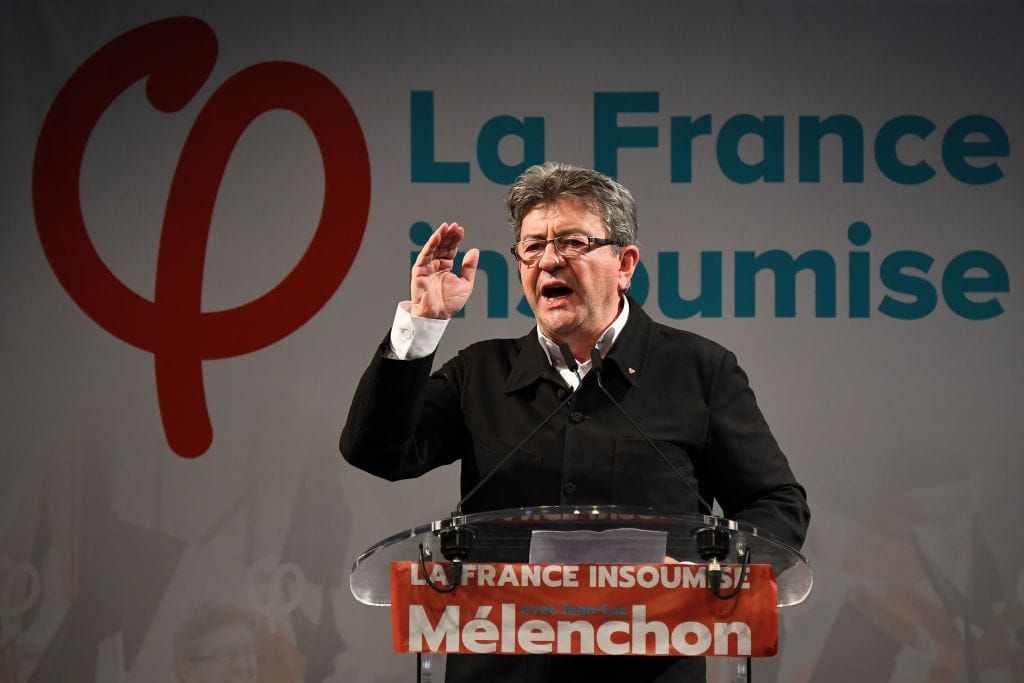
Still, while the media focus mainly on the rise of the far right, another trend is becoming increasingly clear: La France Insoumise is growing, winning over new cities and mobilising working-class communities, workers and young people who had turned their backs on politics for years. The 2027 presidential elections could mark a historic moment. And for the first time in decades, a victory for the radical left now seems possible.
Political crisis and democratic malaise: Macron’s authoritarian neoliberalism
These local elections took place against the backdrop of increased deterioration of democratic life in France in recent years. Emmanuel Macron’s two terms as President since 2017 have been particularly violent in this regard.
One must first recall the arrogance and violence with which the French government forced through its reactionary pension reform in 2023, against the will of the totality of the country’s trade unions, of an overwhelming majority of the population, of a massive social movement that brought several million people to the streets for several months, and of the majority of Parliament.
This circumvention of democratic procedures took place at a time when Macron and his successive governments had already for many years ignored the demands of the impressive wave of protests and social movements that France has been witnessing since 2015. These included the Gilets jaunes movement in 2017–18, the mobilisation opposing Macron’s first attempt at pension reform in 2020, and more generally the movement for environmental and climate justice, among others. All of them experienced an alarming increase in legal and police repression, raising concerns about the authoritarian turn Macron’s administration has been taking.
Yet Macronism has not merely undermined France’s democratic institutions through an authoritarian interpretation and use of the constitution (in particular the infamous article 49.3) to ram through its anti-popular laws and budgets. Nor has it merely mistreated social movements. It has also come to the point of no longer respecting the outcome of the ballot box. In fact, as its policies became increasingly unpopular, the presidential majority has dwindled away.
In 2022, immediately after Macron’s re-election, where he again cast himself as a democratic ‘bulwark’ against the far-right Marine Le Pen (RN), the presidential camp secured only a plurality, and not an absolute majority, in the National Assembly. This was a rare occurrence in the history of the Fifth Republic. This did not, however, prevent Macron from pushing through his counter-reforms and austerity budgets by invoking article 49.3 repeatedly in the years that followed, despite his promises to respect the vote of the millions of people who had reluctantly cast their ballots for him to block the far right — and not to support the ideas he championed. On the night of his election, he had declared: ‘I am aware that this vote places an obligation on me for the years to come’. It was pure hypocrisy.
Macronism has not merely undermined France’s democratic institutions through an authoritarian interpretation and use of the constitution … [but] also come to the point of no longer respecting the outcome of the ballot box.
Unsurprisingly then, two years later, in 2024, new parliamentary elections — forced by Macron’s decision to dissolve the National Assembly, following his defeat in the European elections at the hands of the RN — continued to highlight the popular rejection of the president. Thanks to an impressive grassroots and political mobilisation by the French left, however, it was ultimately the New Popular Front (NFP) — a broad coalition of the Left comprising LFI, the PS, Les Écologistes, the French Communist Party (PCF), and the New Anti-Capitalist Party (NPA) in particular — which came out on top in the runoff contests. It took 193 out of 577 seats, thus securing a relative but not absolute majority. According to French political tradition, Macron should therefore have appointed a Prime Minister from the NFP to form a new government — the senior civil servant and social activist Lucie Castets was the choice put forward by the united left at the time. Instead, after several months of procrastination and stalling, Macron decided to appoint the centre-right European bureaucrat Michel Barnier, tasked with continuing to pursue the same neoliberal policies that had plunged the country into political crisis. Less than three months later, his government was brought down.
This was followed by a succession of Macronist governments that were as short-lived as they were unpopular: that of François Bayrou, a centrist who was ousted after eight months; and Sébastien Lecornu, a Macronist who resigned the day after his first government was formed, only to be reappointed by Macron four days later. This political crisis, now ongoing since 2024, is unprecedented in the Fifth Republic. It has forced the presidential minority, in order
Macron’s crew and France’s economic elites know that the National Rally is actually their lifeline, whilst the radical left is their real political enemy.
to continue passing legislation, to seek ad hoc alliances further and further to the Right, but also with the PS, which was quick to betray its allies in the NFP.
It is thus hardly surprising that Macron’s party Renaissance suffered a crushing defeat in the March 2026 local elections: whereas it had fielded 247 lists in 2020, at these more recent contests the Renaissance party fielded just seven, preferring to join forces with coalition or ‘centre-diverse’ lists. Above all, there are only eight municipalities where the elected lead candidate is a member of Renaissance, including just two ‘major cities’ (with over 100,000 inhabitants), Annecy and Bordeaux, and mostly small towns.
Although Macron cannot run for a third straight term in 2027 and is visibly unwilling to promote a dauphin from within his own ranks — despite the already announced candidacies of two of his allies, Gabriel Attal (Renaissance) and Édouard Philippe (Horizons) — Macron may be hoping to return to power in 2032. To that end, he knows that the best-case scenario would be for the RN to rule for the next five years — allowing him, in his calculations, to present himself again as the ‘bulwark’ against a possibly discredited extreme right. This is not mere paranoid fabrication: it has been revealed by the press that Macron’s decision to dissolve the National Assembly after the 2024 European elections pursued the precise objective of governing together with the extreme right.
Beyond Macron, furthermore, it is clear that a growing section of the bourgeoisie wishes to shift the political balance of power permanently to the right and pave the way for the far right to come to power — most likely through a ‘union of the right’ similar to the one already seen in Italy. Lately, the RN has increasingly engaged in meetings with France’s business leaders.
Political polarisation and the marginalisation of the radical left
Macron’s crew and France’s economic elites know that the National Rally is actually their lifeline, whilst the radical left is their real political enemy. This is why their political camp — the neoliberal bloc — has done everything possible in recent years to stir polarisation of the political landscape, ostracising LFI, while throwing the road wide open to the extreme right.
La France Insoumise, around which the left-wing bloc has reconfigured itself since 2017 on a platform of breaking with neoliberalism, is increasingly being demonised by the political and media elites. During the early years of its existence (since 2016), the radical left-wing party was already being accused of ‘populism’, fiscal irresponsibility and a lack of internal democracy, whilst its leader Jean-Luc Mélenchon was accused at times of being authoritarian and defying the judicial institutions, and at other times of being complacent towards certain foreign powers such as Russia and China.
But in recent years, particularly since October 2023, the country’s leading left-wing party has also been accused of antisemitism for its support to the Palestinian cause and its condemnation of the genocide in Gaza, as well as of courting racialised voters due to its support for the fight against Islamophobia, its engagement in working-class neighbourhoods, and its condemnation of police violence. It is also regularly accused of ‘disrupting’ — ‘bordéliser’ in the words of the then Minister of Justice Éric Dupont-Moretti — French political life, due to its confrontational approach to opposition in parliament and its commitment to social struggles. For several years now, politicians on the right and centre — such as former Prime Minister Élisabeth Borne — have accused LFI of being ‘outside the republican spectrum’, comparing it in this regard to the RN, and pitting the ‘extremes’ against one another in order to demonise the radical left. The decision by the Interior Ministry this past February to classify LFI as an ‘extreme left’ party (and no longer simply ‘left-wing’) ahead of the local elections was, of course, a step in this direction.
Very recently, just a few weeks before the local elections, the death of a young neo-Nazi activist, Quentin Deranque, following clashes between fascist and anti-fascist groups in Lyon, provided an opportunity for the mainstream media and a large section of the political elite to take their efforts to polarise and marginalise the radical left to a new level. Although the circumstances of the death in question have yet to be clarified, the anti-fascist movement as a whole and the LFI in particular have been accused by their detractors of nothing less than complicity in murder. To add insult to injury, the RN, like the president of the Republicans, Bruno Retailleau, did not hesitate to call for a ‘blockade’ against the LFI in the local elections.
Against this backdrop, the other main left-wing parties, which allied with LFI in the 2022 parliamentary elections (within the Nouvelle Union Populaire Écologique et Sociale, NUPES) and in 2024 (with the NFP), are thus constantly being urged to rule out any alliance with this ‘dangerous’ party. This seems to suit them down to the ground. Indeed, many leaders of the PS, the Greens and the PCF have not hesitated to comply and to participate in this process of dividing the Left and marginalising LFI, for reasons of short-term (local) and medium-term (presidential and parliamentary) electoral calculations.
Having been resurrected thanks to its alliance with La France Insoumise in the past parliamentary elections, the Socialist Party now hopes to win back the voters it has lost to Emmanuel Macron since 2017. The PS believes, indeed, that the fragmentation of the Macronist bloc, in the absence of a natural dauphin, could work in its favour if it presents a centrist option in the presidential election, centred on Raphaël Glucksmann or former lamentable president François Hollande. Contrary to their campaign promises, and despite having been elected on a programme of radical change largely shaped by La France Insoumise, Socialist MPs have, in recent years, chosen not to censure the governments of Bayrou and Lecornu. They portray themselves as pragmatic brokers committed to preserving political order, claiming they can negotiate limited adjustments to blunt the harshest social consequences of the latest fiscal package — especially the reversal of pension provisions. In practice, however, these negotiations produced almost no meaningful change: the austerity agenda stayed intact, while the supposed gains amounted to little more than symbolic concessions.
Although in parliament the Greens and the PCF voted alongside LFI for the motions of no-confidence in Macronite governments, they reached agreements with the PS in the first round of these local elections in most towns, and rarely made deals with LFI. The aim, for the leaderships of the three traditional parties of the French left, was to prevent left-wing voters from preferring La France Insoumise, in order to retain power in town halls and secure a place in future majorities. And, by extension, to be in a stronger position ahead of the next presidential elections. These calculations and contradictions led the Left to forge alliances of varying composition, rallying behind the highest bidder, depending on the election.
These strategic choices have, of course, been contested internally, and ‘rebel’ alliances have emerged, for example between France Insoumise and the PCF in Seine-Saint-Denis, a working-class suburb of Paris where the Communists retain a strong foothold. Several hundred Green Party activists and officials, moreover, signed an open letter opposing these alliance decisions, and some joined LFI in several major cities, notably in Paris.
Notwithstanding these rare alliances, Mélenchon’s party went into the local elections in a fairly isolated position and was not expected to secure many victories. LFI thus needed to make a strong impact in the first round so that it could then negotiate with its left-wing ‘frenemies’, with a view to securing a presence on local councils and, perhaps finally, a few senators (who are appointed by local councillors). Only then could the party reimpose its standing within the Left and get out of its marginalised position, not just in the major cities’ elections but also, of course, at national level.
Results in brief
The first notable trend in these elections was the continuing rise in abstention, which has been steadily increasing throughout the neoliberal era. Admittedly, abstention was actually higher in the last local elections in spring 2020, but these had also taken place against the quite specific backdrop of the early months of the COVID-19 pandemic and can hardly serve as a point of reference (back then, abstention reached 55 percent in the first round and 58 percent in the second). With this exception, therefore, the latest election marks a record level of abstention in the history of the Fifth Republic: 43 percent, seven percentage points higher than in 2014.
This is a key issue, particularly for the Left’s hopes of electoral victory. Indeed, we know that abstention is more prevalent among certain sections of the population whose interests and values are most closely aligned with the Left: the working classes and young people, in particular. This abstention, as we know, is no accident: it is one of the symptoms of a rejection of the political process by the working classes, who feel increasingly neglected and betrayed by this same process. People see less and less how elections can improve their lives, particularly at local level where the power of elected representatives is limited. Furthermore, many potential voters are regularly excluded from voting because they are unregistered or incorrectly registered, due to unsuitable administrative conditions for registration on the electoral roll. Consequently, the influence of the older electorate increases all the more, favouring conservative forces.
Aside from the low turnout, the main winners are the classic left and right-wing parties. The traditional political system that has collapsed at national level — characterised by the alternation between the right-wing LR and the PS — con-tinues to hold its ground at local level. The PS, a party largely made up of local elected representatives, retains roughly the same number of elected officials, votes and municipalities. Paris remained in the hands of the Socialists, allied with the PCF and the Greens, who prevailed against the alliance of the right and centre, despite the sustained candidacy of rival left-winger Sophia Chikirou (LFI). So did Marseille, though there the LFI candidate had stepped down ahead of the runoff faced with the risk that the RN candidate would win. It is worth recalling that the PS had, however, collapsed since the end of François Hollande’s disastrous term ten years ago: in the last presidential election in 2022, it secured 1.74 percent of the vote, although it subsequently regained some ground in the parliamentary elections thanks to its alliances with LFI. This resilience at local level is enabling these political parties to rebuild their strength to some extent, and to look forward to the upcoming national elections with a little more confidence. The PS did, however, lose some town halls, notably in a few places where it had joined forces with LFI in the second round — the electoral breakthrough made by La France Insoumise in the first round having forced several Socialist lists, despite the opposition of the PS leadership, to ally themselves with La France Insoumise. This was the case in Brest, Clermont-Ferrand and Besançon, which were lost to the right, but in just as many towns, such as Lyon, Nantes, Tours and Grenoble, alliances with LFI secured a victory for the Left. Are the cities lost by the united left attributable to alliances with the bête noire LFI, or rather to the rejection of outgoing PS mayors (in Brest or Clermont, for example), or even because the PS is paying the price for its involvement in the lynching of the FI? According to political scientist Samuel Hayat, it is rather the over-mobilisation of right-wing and far-right voters against the united left in the second round that is responsible for these defeats. This has, of course, not prevented the Socialist leadership from blaming LFI and Mélenchon — a ‘dead weight’ for the Left, according to the PS First Secretary Olivier Faure — for its defeats in the second round.
Besides the PS, the Communist Party remained the second biggest left-wing force in local politics, although it lost many of its town halls, falling from 32 to just 19, saved by its alliances with the PS and, less frequently, with LFI. The
Abstention is more prevalent among certain sections of the population whose interests and values are most closely aligned with the Left.
Greens, for their part, suffered a significant decline. Following a green wave in 2020, likely due to the context of COVID-19 and the Fridays for Future movement, which had brought political ecology to the forefront, the Greens retained Lyon, Grenoble and Tours but lost several major cities, such as Bordeaux, Strasbourg, Poitiers, Besançon and Annecy. This could in part be a result of poor performances by the Greens in government in the past six years, but it also results from the fact that some of its more radical constituency is captured by LFI. This latter is, arguably, the most environmentally conscious party in terms of programme and mobilisation, whilst upper-class environmentalism is easily captured by Socialists and Macronists.
Furthermore, as noted above, although the centre camp as a whole — Renaissance, Horizons, the MoDem, etc. — remains in third place, Macron’s party continued to plummet in these elections. As for the main forces of the far right and the radical left, the National Rally and La France Insoumise, they remain a minority in the local French political landscape, but relatively speaking, both parties did indeed make a ‘breakthrough’ in these local elections.
A limited far-right advance… not to be ignored
Despite setbacks in a few large cities such as Nîmes and Toulon, the RN continues to rise. Not in the major university cities, admittedly, but in small and medium-sized towns, such as Boulogne-sur-Mer, where it increased its share of the vote from 15 to 33 percent. The far right has increased the number of town halls it controls fourfold in six years, rising from just over fifteen municipalities in 2020 to around sixty in 2026. Most of these were single RN lists, but far-right coalition lists also won their elections, such as in La Seyne-sur-Mer, in the Var. The party of the tricolour flame now governs twelve towns and cities with over 30,000 inhabitants, such as Nice (via ally Éric Ciotti) and Carcassonne, compared with three previously.
This progress should not be underestimated by our camp. Although there has been no landslide victory for the far right, its local presence continues to grow, reinforcing its hegemony in national elections. It is worth recalling that, despite the court convictions handed down to Marine Le Pen, the party has made considerable gains since the start of Macron’s first term in 2017. It rose from 21.3 to 33.9 percent in the second round of the presidential elections between 2017 and 2022, from 23.3 to 31.4 percent between the 2019 and 2024 European elections, and from 8 to 89, then 122 MPs in the National Assembly between 2017, 2022 and 2024, where it now holds the largest political group. It leads by a wide margin in voting intentions for the next presidential election, as the polls — even though they tend to significantly overestimate its support — put it at between 34 and 38 percent, far ahead of potential candidates from the centre and the Left.
This trend is clearly owed to several factors that can be observed in most European countries. Whilst it does not make a victory for the far right in the next national elections inevitable, it is obviously very worrying. All the more so as this surge is fuelling a dangerous merger between the right and the far right, following the Italian model, which is far from complete in France but is gradu-ally emerging, both at the leadership level and, above all, among the electorate. As is the case across Europe, the rise of the far right has in fact been both the cause and the consequence of a radicalisation of the traditional right. We saw this, for example, in the Parisian elections, where Rachida Dati, the LR candidate close to Macron’s camp, focused her campaign entirely on issues of policing, security, violence, immigration, etc., and secured the withdrawal of extreme-right Reconquête candidate Sarah Knafo to her advantage in the second round. This dynamic is leading to an increasingly marked convergence of positions between the two right-wing blocs serving capital. It also most often allows the far right, particularly the RN, to siphon off the bourgeois right’s electorate whilst ensuring the loyalty of its working-class base (particularly in the deindustrialised regions of northern France).
Radical-left breakthrough, despite demonisation
Fortunately, at the other end of the political spectrum, despite a smear campaign on an unprecedented scale and despite its isolation on the Left, La France Insoumise held its ground and made headway. It went from winning two town halls in 2020, thanks to coalition lists, to winning seven town halls in 2026 under its own banner. In the first round of these 2026 elections, it won Saint-Denis in the Paris suburbs, one of the poorest towns in France. It then won other major towns in the second round: Roubaix and Le Tampon (taken from the Right) as well as Creil, Vénissieux, La Courneuve and others. 550,000 French people now live in towns governed by La France Insoumise, compared to 30,000 previously. Founded in 2016, LFI had only contested one local election campaign to date — the 2020 campaign during the COVID-19 pandemic — which it largely overlooked, partly because it initially focused its efforts at the national level. Six years later, LFI this year succeeded in establishing itself at local level, particularly in France’s working-class urban and suburban neighbourhoods. It has achieved this notably through the development of detailed programmes, drawn up following extensive consultations with local civil society activists. In Paris, a 170-page programme was thus put together.
This breakthrough is also, and above all, the result of a political strategy aimed at mobilising the social classes and generations most affected by abstention. Indeed, to broaden the electoral base of the left-wing bloc and aim for victory, the party-movement has, for some years now, opted to re-mobilise abstainers, a large proportion of whom, according to sociologists, are ‘intermittent’, meaning they may turn out to vote when the political stakes seem particularly high. This strategy is prioritised over one that would involve courting centrist voters (Macronists and Hollande supporters, for example) or the ‘fâchés pas fachos’ (‘fed up but not fascists’ — those working-class voters who have turned to the far right without necessarily being racist.
This mobilisation of non-voters is partly achieved through door-to-door canvassing, carried out extensively in working-class neighbourhoods and social housing estates by grassroots activists, not only in the run-up to elections but also over the longer term. This mobilisation relies on the grassroots work of a growing number of activists. Despite the extremely difficult context of stigmatisation and slander against La France Insoumise, who were accused on every television programme of being antisemitic and complicit in murder in the run-up to the elections, this campaign, like others, has enabled the recruitment of many new activists. In Paris’s 10th arrondissement, for example, as highlighted by the lead candidate Marion Beauvalet, several people joined the campaign in response to the extreme political and media witch-hunt that was relentlessly targeting LFI.
The mobilisation of voters in working-class neighbourhoods is also due to the socially diverse composition of the ‘Insoumis’ lists. Indeed, several elected mayors, such as Bally Bagayoko in Saint-Denis, as well as many candidates on the party’s lists, are of immigrant background. Far from being merely a token gesture, this represents the long-awaited reconciliation of the Left with the ‘cités’. This rapprochement was initiated by LFI as early as 2019, with its — controversial — participation in a major demonstration against Islamophobia, and particularly since 2023 thanks to its uncompromising stance on the genocide in Gaza, a crucial issue for a large proportion of working-class populations subject to racial discrimination. It is also the result of Mélenchon’s mobilisation, over several years, of the concept of ‘creolisation’—borrowed from the Martinican poet Édouard Glissant—and, in the run-up to these elections, that of the ‘new France’, to conceive of a nation whose vitality stems from its multiple heritages—in terms of origins, class, religion, age, gender, etc. — but which is united by a shared political project of emancipation.
It was therefore this strategic mobilisation effort, combined with a solid policy platform and the social diversity of its representatives, that enabled the FI’s breakthrough — one the media had completely failed to foresee. The question now is whether this breakthrough gives us grounds to hope for a victory for the Left in the next presidential election, in 2027.
Toward a left-wing victory?
A section of the left, both within the party apparatus and among voters, believes that a left-wing victory in the 2027 presidential elections will only be possible with a ‘united’ left-wing candidacy. This is off to a bad start given the divisions within the Left mentioned above. At the beginning of April, France Insoumise leading figure Manuel Bompard’s offer to the PCF and the Greens to form an alliance ahead of the next national elections has been declined by the two parties. However, two petitions were launched simultaneously in the wake of the local elections calling for a left-wing primary: one by Clémentine Autain, a former La France Insoumise MP who founded her own party, ‘L’Après’, in 2024; the other by François Ruffin, an MP formerly close to La France Insoumise and founder of the ‘Debout!’ party. This primary, which is due to take place in the autumn, is supported by Marine Tondelier, secretary of Les Écologistes, and by the small party Génération.s. The PS and the PCF are dithering. LFI and Place Publique, the small centre-left group of apparatchiks whose leader, Raphaël Glucksmann, is the mainstream media’s favourite left-wing candidate, have announced that they will not be taking part.
A unified candidacy is, therefore, highly unlikely. Already in 2022, a similar attempt at a ‘People’s Primary’ ended in humiliation for those involved: the winning candidate, Christiane Taubira, failed to secure enough signatures from elected representatives to stand for election. Furthermore, although the ‘unifiers’ are convinced that the lack of unity on the Left is due to ‘ego clashes’, which could easily be resolved by a primary, the truth is quite different. On the one hand, there is the issue of programme compatibility, which is by no means insignificant, and which raises the question of a possible union between a radical left (like LFI) and a left that compromises (notably the PS) with neoliberal capitalism. Although the NUPES and the NFP have existed in recent years on a programme of radical change imposed by LFI thanks to its dominant position in the presidential elections, we have seen how quick the PS was to betray this programme by supporting a budget that endorses twenty billion euros in austerity cuts. On the other hand, voters may not be convinced by another union candidacy of the Left following the grim spectacle of divisions and conflicts we have witnessed over the past two years.
If this primary does indeed take place, LFI will therefore find itself facing a moderate ‘non-Mélenchonist’ wing of the left, united around the Greens, and a right-leaning wing of the Left that is fiercely anti-LFI, centred on Glucksmann or Hollande. The Insoumis, undoubtedly represented by Mélenchon for the fourth time, will therefore have to form a radical pole capable of presenting itself as a genuine alternative in order to qualify for the second round. Given that the polls — whatever one may think of them — currently give the RN a lead of around 20 points over Mélenchon, this endeavour may seem hopeless.
Sociologist Manuel Cervera-Marzal — by no means a die-hard supporter of La France Insoumise — argues not only that LFI is not likely to finally make it through to the second round, but that victory for Mélenchon is the most probable outcome of these next elections. He bases his analysis on a detailed study of electoral data, sociological research and several historical precedents, and highlights Mélenchon’s steady electoral progress over the past fifteen years, his unrivalled experience of presidential campaigns, his recognised oratorical skills, his systematic underestimation by the polls, the collapse and fragmentation of the centrist bloc, the lack of a credible alternative on the left, the persistence of left-wing values among the French population despite a shift to the right in the political landscape, and the organisational and activist structure of the Insoumis party.
If LFI makes it through to the runoff, even with a possible ten-point lag behind the RN, Cervera-Marzal considers it likely that it can turn the situation around. He rigorously examines each of the factors at play between the two rounds and explains that the highly fluid nature of voter behaviour, a likely surge in turnout, Mélenchon’s comparative advantage in a televised debate, the highlighting of the RN’s economic and geopolitical contradictions, a certain patriotic reflex, as well as a share of votes shifting from the centre and the remobilisation of abstainers — who are generally closer to the Left than to the far right—could well shift the balance.
Of course, a great deal could happen over coming months that might turn the campaign on its head — including a devastating world war or, why not, a financial crisis of unprecedented severity. The Macronist camp could restructure itself and impede Mélenchon’s qualification for the second round. We could also see foreign interference in the campaign: French journalists have, in fact, revealed that Israeli lobbies meddled in LFI’s affairs during the last local elections. However, for the time being, it seems that a victory for the radical left in France is possible for the first time in many decades. A left that will also, we hope, have the advantage of having learnt the lessons of the Socialists’ capitulation to the financial markets in the early 1980s.