

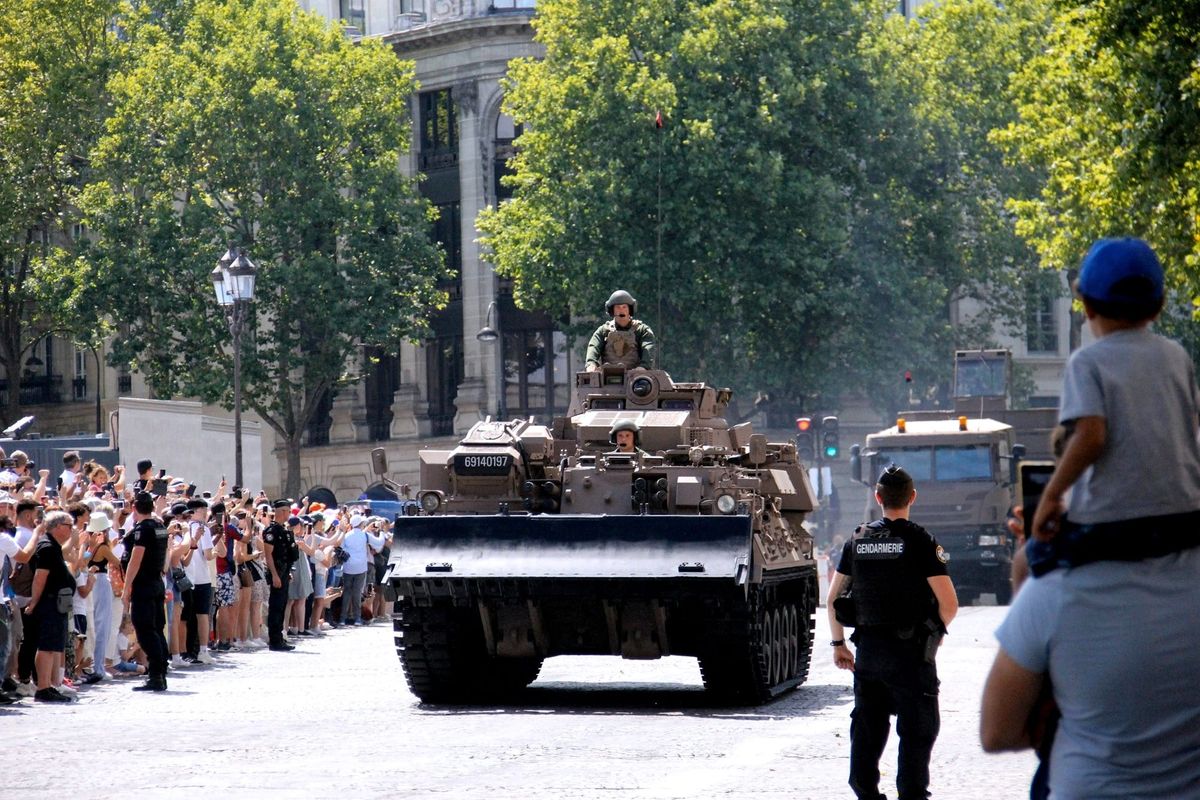
The French military industry plays an essential — albeit discreet — role in the European Union’s political life. It sets the pace for trade, industrial policy, diplomacy, and so on. It must be said that business is booming. Even France’s political and social crisis, which since 2022 has developed into a crisis of parliament and government, has not caused the sector any difficulties. In fact, Brexit has pushed aside one of its main competitors, and the outbreak of war in Ukraine has provided it with a new expansive drive. More recently, the diplomatic and trade crisis between the EU and the Trump administration has allowed it to take on an even more central role. So, where is French militarism headed?
The vote on 14 March
Speaking to L’Express on 9 March 2025, radical-left MP Clémentine Autain called for the left to unite1, telling the magazine: ‘Atlanticism is no more, we are burying a major bone of contention on the left’. She added: ‘No one disputes that we need to invest in our defence, but not at the expense of our social model and ecological transition, but by calling on the super-rich and big corporations to contribute’. The opinion she expressed at the time was (in our view) misguided— but she was not alone, and many people agreed with her.
It is important to remember the context: Donald Trump had just humiliated Volodymyr Zelenskyy at the White House and seemed to be colluding with Vladimir Putin at Ukraine’s expense. For several weeks, the theme of ‘European sovereignty’ dominated public debate. It must be said that the French, British and German ruling classes had reason to feel unsettled; Joe Biden’s administration had dragged them deep into conflict with Russia, and here they risked finding themselves isolated in the face of the ogre, abandoned by their powerful US sponsor.
Part of the left shared this unease. They had long insipidly condemned the US for its excesses, while being well-aware of what the European way of life owes to that country, and the benefits and privileges that Uncle Sam’s Western European allies derive from the Atlantic alliance. Of course, ‘not everything is perfect’. But isn’t it better to live in the orbit of the US than in the orbit of Russia or China?
In practice, the Pax Americana is a boot on the throat of most countries in the world, from the Middle East to Latin America. But in Western Europe, life was sweeter. Donald Trump’s disruption of this balance thus effectively brought together both those who liked the status quo ante (the ‘Atlanticists’) and those who rejected it, as each found themselves in de facto opposition to Washington’s new policy. The brutal purge that Elon Musk was implementing in the US state administration in that same moment, and the intensification of authoritarian policies in the US — particularly at its borders — exacerbated fears about the collapse of what most political forces ultimately consider to be the heart of the free world.
Clémentine Autain’s interview followed a few days after Von Der Leyen’s announcement of the ReArm Europe plan2 and came just before the discussion in France’s National Assembly, on 14 March, of a ‘motion for a European resolution calling for strengthened support to Ukraine’3. Here, France appears as a driving force behind European militarism. For example, the resolution’s paragraph 15 ‘urges the European Union to continue its efforts to increase its arms and ammunition production capacities, both to strengthen aid to Ukraine and to consolidate its own strategic autonomy’.
The ideological offensive was breaking through the ranks of the left. Since the Americans were giving up on protecting the European way of life, we had to take care of it ourselves. Sure, the arms industry isn’t pleasant, but isn’t it a necessity? How could a people, or an alliance of peoples, remain free if it presented itself unarmed on the international stage, where the great predators that are also our neighbours operate?
In the end, the usual ‘Atlanticist’ parties — the Socialists and the Greens — voted for the resolution, while the usual anti-imperialist parties — La France Insoumise and the Communists — voted against it. Perhaps, in the end, the ‘bone of contention’ had not been completely buried.
European sovereignty?
In fact, those who posed the issue in this way forgot one small detail: with the Re-Arm Europe/Readiness 2030 plan, it is not the peoples of Europe who are in control, but the European bourgeoisie, and particularly the French bourgeoisie. And it can hardly be said that the latter has the general interest of humanity in mind. When we look at things from the point of view of the bourgeoisie, which is the approach that presided over the resolution of 14 March, three things become clear. Firstly, it is quite obvious that any strengthening of France (or the EU) on the international stage would immediately translate into a strengthening of Emmanuel Macron and, therefore, of his policies: imperialism abroad and austerity at home. We saw this when war broke out in Ukraine and, in different forms, in the weeks following 7 October 2023. More generally, this phenomenon is closely linked to the history of our country. Since Napoleon Bonaparte, we have known
Part of the left shared this unease. Isn't it better to live in the orbit of the US than in the orbit of Russia or China?
that an international hero has a free hand to carry out his political project. This is because, as Carl von Clausewitz and Vladimir Lenin each said, war is the continuation of politics by other means. In fact, the foreign policy of Macron and the capitalists who support him is entirely consistent with their domestic policy. Attempts to escape this powerful dialectic by insisting that militarism must not develop ‘at the expense’ of this or that function of the welfare state lead nowhere. You cannot have a half-Macron, Macron’s foreign policy without his domestic policy. Furthermore, the ties between the French bourgeoisie and US capital are too close to be broken so easily. In fact, at the end of 2023, non-residents held nearly 50% of the capital of the companies listed on Paris’s CAC 40 stock exchange. US capital accounts for 36.6% of these non-residents, 39.5% is held by Eurozone countries, which are direct vassals of the US (Germany, etc.), and just under 10% by the United Kingdom, likewise a vassal. This means that the Atlantic alliance under US leadership controls nearly half of the CAC 40. Even disregarding the dependencies linked to raw materials, Big Tech or dollar hegemony, this means that if a country like France were to break away from the US’s orbit, it would have to massively challenge the principles of private property and drive out the legal owners of the largest companies. This is naturally out of the question for the parties in power. As a result, European and US policies remain closely linked. Trump is not at all bothered by the Europeans’ ‘sovereign’ initiatives, since the requirement to increase their contribution to their own defence to 5% of their GDP, for example, came directly from him.
Finally, the very idea of a ‘sovereign’ European military industry whets the appetite of French employers. The latter largely dominate the sector and see it as an opportunity to obtain a quasi-monopoly position in a market as large as a continent, whose players worry that the rumblings of war will reach their gilded salons. However, French weapons are not particularly emancipatory for the peoples of the world. They fuel conflicts around the globe, between Ukraine and Russia, between Yemen and Saudi Arabia, between Israel and Palestine, between India and Pakistan... French politicians who claim that our weapons are morally superior to those of the Americans or Russians would draw expressions of contempt or indignation from most nations around the world.
The political economy of the French military industry
In fact, France is the world’s second largest arms exporter (behind the US). For its ruling class, war is also the continuation... of economic policy.
The military industry not only arms France’s projection of its power abroad (111 foreign interventions between 1991 and 2015). It forms the backbone of French capitalism, centred around nine major monopolistic or quasi-monopolistic players with extreme capital concentration: Airbus (defence and space), Ariane Group (ballistic missiles and space launchers), Arquus (military vehicles), Dassault Aviation (military aeronautics), MBDA (missiles), Naval Group (military shipbuilding), KNDS (land weapons), Safran (engines and equipment) and Thales (defence electronics). The ‘Defence Industrial and Technological Base’ (BITD) also includes 4,500 intermediate or medium-sized companies and represents a total of around 200,000 direct and indirect jobs4. It forms a structuring web of activities in industrial zones, maintaining close links with other sectors such as metallurgy, electronics, chemicals and energy.
The extreme concentration of the sector is the result of an economic policy pursued under the aegis of the French state to gain competitiveness after the Cold War, when the global demand for armaments was declining. The state thus merges its interests with those of big industrial capital, both as a customer and a client of these companies— the 2024-2030 Military Programming Law provides for a defence budget of €413 billion — and, in many cases, as their owner. For example, it remains the majority shareholder in Naval Group. This military-industrial complex is thus also deeply political. The state communicates with the BITD through dedicated institutions (such as the Directorate General of Armaments), defence employers’ organisations (GIFAS, GICAT, etc.) and exchanges between senior civil servants and arms companies. Thus, the military roots of the Fifth Republic, founded by General Charles de Gaulle, are neither merely symbolic nor reducible to its historical origins. They shape its agenda in the here and now.
This is especially reflected in France’s international policy. The government and the President of the Republic regularly put their diplomatic activity at the service of the industrial interests of the BITD. Several landmark contracts have punctuated the last decade: the sale of 24 then 30 Rafale aircraft to Egypt (2015 and 2021), 36 Rafale aircraft to India (2016), 80 Rafale aircraft to the United Arab Emirates (2021), Scorpène submarines to India and Brazil, and FREMM frigates and Gowind corvettes to several navies (Morocco, Egypt, Malaysia). This international — and diplomatic — nature of the French military industry is reflected in the sector’s industrial and capital alliances; missile manufacturer MBDA, for example, is a pan-European joint venture.
France’s military industry as a force for European rearmament
The ‘rearmament’ of Europe means two things for the French military industry: the opening of new markets and access to new resources.
In fact, plans to provide military aid to Ukraine are an opportunity for French capitalists to accumulate more capital; they are paid for these goods, in these contracts as in ordinary contracts. Typically, the EU’s commitment to deliver two million rounds of ammunition in 20255 drives the machine: Thalès, for example, has received an order6 to increase its production of 120mm ammunition at La Ferté Saint-Aubin. Who pays the bill? Directly, the French state, which places orders under the Military Programming Law.
The French state itself can draw on resources pooled within or by the European Union. This takes certain particular forms, such as:
— Bilateral cooperation within the framework of ‘capability coalitions’, where a partner country contributes to the financing of the project; such is the case of the French-Danish cooperation for the delivery of CAESAR cannons.
— Reimbursement to states for military expenditure incurred; in this respect, the European Peace Facility Programme7 is mobilising €17 billion between 2021 and 2027.
— Favourable loans for the purchase of armaments. French manufacturers have also secured a partial exclusion of suppliers outside the EU — i.e. US, British, and Turkish suppliers, the main rivals of the French military industry — from the €150 billion fund8 established for this purpose.
The military industry not only arms France's projection of its power abroad. It forms the backbone of French capitalism.
Beyond capturing national and European resources, the resolution proposes seizing the Russian assets frozen under the economic sanctions (more than €200 billion in Europe) to fuel the military industry. It should be noted that for the moment, only the interest generated by these assets is actually being expropriated — for it is best not to break the taboos surrounding private property too abruptly— and not the assets themselves.
In any case, the war in Ukraine has given the BITD an opportunity to effect a change of scale. Is this about ‘arming freedom’, as they say in the National Assembly? Not exactly. In practice, French weapons dealers will sell arms to anyone who wants them, even the worst butchers. The excellent investigative media outlet Disclose has well documented a number of inglorious such deliveries. This is the case with arms deliveries to Saudi Arabia in the context of the war in Yemen, machine-gun equipment9 and armed drones10 supplied to Israel while the massacre in Gaza was raging, and — even in parallel with deliveries to Ukraine — deliveries to Russia which are transited through India11.
Conclusion
This sequence of events has reminded us of a simple fact: in order to maintain a credible internationalist stand and to earn the respect and friendship of the world’s other peoples, you must be able to denounce imperialism in your own country. Otherwise, you will naturally be suspected of passing on the propaganda of your own government, of playing the same role as Macron, that of sales representative for the BITD, but within the social movement. Of course, no one in the French radical left is directly bought by Safran or Thalès. These positions are sincere and have genuinely liberatory objectives. But we must understand and make it understood that French weapons cause harm, that people are dying under Rafale bombs. To claim that this industry is progressive, to call for its strengthening in the name of democracy, is very shocking to these millions of people and creates an insurmountable wall between peoples in struggle.
Does this mean that the only possible revolutionary policy is to call for uni-lateral disarmament, to rely on the invisible hand of good intentions to resolve all the world’s conflicts? No, of course not. The revolutionary governments of the future will need means of combat, in particular to protect themselves from any form of external or internal aggression. But defending the policies of a revolutionary government is not the same as defending the policies of a reactionary government. We want to bring down the current government because it is doing a great deal of harm, both externally and internally. Helping it to strengthen itself is certainly not the best way to achieve this.
Notes
1 Clémentine Autain :“L’atlantisme n’est plus, nous enterrons une pomme de discorde majeure à gauche”‘, L’Express, 9 March 2025.
2 ‘Déclaration de la Présidente von der Leyen sur le paquet défense’,
4 March 2025, https://france.representation.ec.europa.eu/informa-tions/declaration-de-la-presidente-von-der-leyen-sur-le-paquet-de-fense-2025-03-04_fr.
3 https://www.assemblee-nationale.fr/dyn/17/scrutins/988.
4 Ministère des armées, ‘Rapport au Parlement 2023 sur les exportations d’armement de la France’, 15 July 2023, https://www.vie-publique.fr/ rapport/290724-rapport-au-parlement-2023-sur-les-exportations-darmement-de-la-france.
5 ‘EU military & defence support to Ukraine’, 11 September 2025, https:// www.eeas.europa.eu/eeas/eu-military-defence-support-ukraine_en.
6 ‘French army places new ammunition order with Thales’, Reuters, 17 June 2024, https://www.reuters.com/business/aerospace-defense/ french-army-places-new-ammunition-order-with-thales-2024-06-17.
7 European Peace Facility, https://www.consilium.europa.eu/en/policies/ european-peace-facility/.
8 ‘EU to exclude US, UK and Turkey from €150bn rearmament fund’, Fi-nancial Times, 19 March 2025, https://www.ft.com/content/eb9e0ddc-8606-46f5-8758-a1b8beae14f1
9 ‘La France s’apprête à livrer des équipements pour mitrailleuses vers Is-raël’, Disclose, 4 June 2025, https://disclose.ngo/fr/article/la-france-sapprete-a-livrer-des-equipements-pour-mitrailleuses-vers-israel.
10 ‘En pleine guerre à Gaza, la France équipe des drones armés israéliens’, Disclose, 17 June 2024, https://disclose.ngo/fr/article/en-pleine-guerre-a-gaza-la-france-equipe-des-drones-armes-israeliens.
11 En pleine guerre en Ukraine, des milliers de composants Airbus et Boe-ing équipent l’aviation russe’, Disclose, 20 February 2025, https://dis-close.ngo/fr/article/en-pleine-guerre-en-ukraine-des-milliers-de-com-posants-airbus-et-boeing-equipent-laviation-russe.