

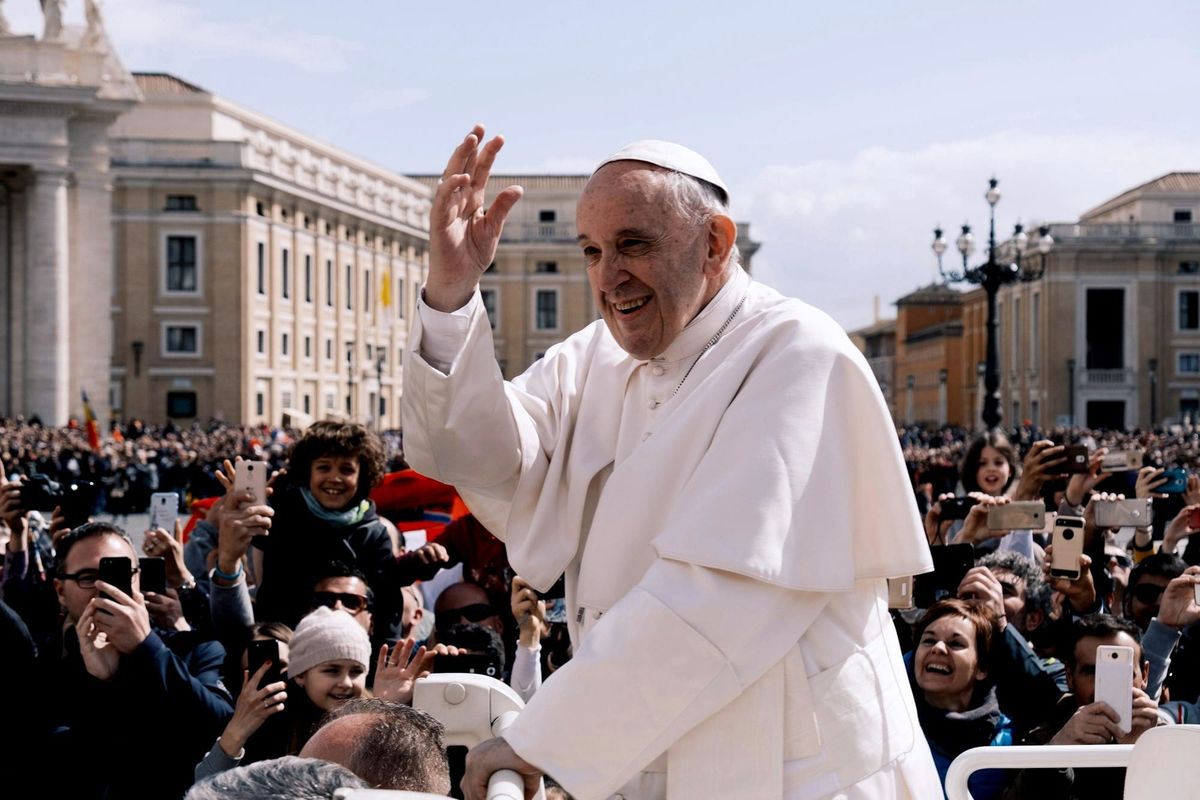
On 24 April 2025, a few days after the death of Pope Francis, the moderate German newspaper Die Zeit1 featured a front-page photograph of him accompanied by the question, ‘The Last Leftist?’ The query was further contextualised with a subtitle expressing concern over whether the Pope’s passing might signal a shift of the Church toward the political right. Over the course of his twelve-year papacy, Francis was frequently characterised as a communist, Marxist, or socialist — either as a means of criticism by conservative factions within Catholicism and the political right, or as a form of endorsement by social activists and the political left in Europe and the Americas.
Matthew before Lenin
The almost reflexive tendency, on both sides of the spectrum, to label Francis as ‘red’ arises from the perception that the values he has passionately defended and pursued within an institution as rigid and hierarchical as the Catholic Church are fully aligned with the left and, conversely, dissociated from Christianity. Social justice and equality, fraternity and solidarity, freedom, and peace — when articulated within a universal narrative about humanity’s social destiny, framed as a call to action — are almost automatically read as socialist. Addressing issues such as poverty, migration, war, or climate catastrophe seems to render one, in the eyes of many, a communist. Yet both conservative Catholics (and naturally Orthodox believers) as well as leftist commentators often overlook that these values were held long before Marx, Engels, or Lenin. Jesus did so, and the apostles, centuries before the emergence of the communist movement, proclaimed a vision of emancipation and liberation. As Francis himself observes in his autobiography: ‘I once said that the communists stole the flag from us because the flag of the poor is Christian, and this is undoubtedly true. The Gospel, chapter 25 of Matthew, the record on which we will be judged, comes long before Lenin’2 Centuries of institutionalisation within the Church, its consistently reactionary political stances — including, on occasion, support for ruthless dictatorships — its repeated entanglements with the state3 (most notably in the present day the Moscow Patriarchate and Russia), and its growing detachment from the concrete realities of human life — its social problems, questions, aspirations, and hope — have drained Christianity of its vital essence: the Gospel message. It was to this very Gospel message that Francis devoted himself, anchoring his papacy in a renewed vision of faith engaged with the world.
‘The Gospel, chapter 25 of Matthew, the record on which we will be judged, comes long before Lenin.’
— Pope Francis
Born in Latin America to an immigrant family, a Jesuit, and deeply rooted in the lives of the people, Francis grew up surrounded by the diversity of ethnic, religious, and cultural backgrounds. His love for the people he served never wavered, and even as Pope he chose to live in the clergy guest house in Santa Marta, rather than the more isolated and sumptuous Apostolic Palace. His decision to become a priest was motivated by a desire to walk with the people of God, an idea that remained at the heart of his papacy. His personal journey is intertwined with his broader social and political theology. The ‘people’ he refers to are not abstract concepts but the poor, the oppressed, and those who are marginalised in society. For Francis, the Iglesia Militante (Militant Church) exists for them, and the Church must take a firm stand against the exploitation and oppression of the poor. In contrast to a church that hesitates to take a stand and name the exploiter, fearful of compromising its universality and ecumenism, Francis redefines ecumenism through the preferential option for the poor, drawing on the great legacy of liberation theology. He stresses, by way of the ‘theology of the people’4 (teología del pueblo), that the Gospel was conceived for the poor and the reprobates as its first addressees, pointing out that the people, the ones who inhabit the villas miserias, the outcasts of ‘an economy that kills’, constitute the subject of the Church’s historical soteriology.
Catholic social teaching
Consequently, Francis did not trouble right-wing and conservative Catholicism simply by speaking about the poor. Everyone speaks about the poor, not only all popes and religious leaders, but also economic elites when they display their philanthropy or address poverty in a village in the Zinder region of Niger — while turning a blind eye to the poverty at their doorstep, under the bridges of Paris, or in the shantytowns of Mississippi. Francis provoked because he spoke of the poor as the social consequence of an exploitative economic system that destroys both human lives and the natural environment for the sake of profit. He grounded this critique historically and sociologically — drawing on his social theology — by highlighting the condition of the exploited, a category that statealigned Christianity approaches almost fatalistically, not only forgetting the Church of the early Christian era but also neglecting an entire tradition inaugurated by Pope Leo XIII and his groundbreaking encyclical Rerum Novarum (1891): the Social Doctrine of the Catholic Church, a body of socio-theological thought that continues to develop to this day with the aim of grounding the Gospel message in contemporary social realities.
Catholic Social Teaching (CST) refers to the body of doctrine developed by the Catholic Church’s hierarchical magisterium, addressing ethical, economic, and political issues in society. The very production of this body has been the result of the Church’s engagement and dialogue with the sociopolitical debates in particular historical moments. Roger Aubert, the Belgian church historian specialising in modern Catholicism, has demonstrated how the papal documents learned much from what Catholic theologians and social activists were saying and doing. Sometimes the impression is given that papal and hierarchical documents simply come from the top down in some type of vacuum. The very way in which the papal documents are drawn up adds to this impression ... the drafters learned from other Catholic theorists and activists so that the final encyclical, in reality, relied heavily on the broader dialogue and discussion within the Church5.
As we noted, the Church is among the most rigidly institutionalised bodies, the oldest surviving institution of our societies, and consequently it can mistakenly believe that its structural conservatism is the only means through which it can reproduce itself. Actually, from our historical vantage point, it is difficult to fully recognise the profound changes to which the Church has been — and continues to be — subjected precisely in order to reproduce itself. The CST is one of these major transformations, with the goal of making it a part of modern society, shaped by mass democracy and capitalism. When, in 1891, Pope Leo XIII wrote in Rerum Novarum6 that workers should organise and be protected through their trade unions, he may have been late in comparison with the socialist movement, but it was the first strong institutional voice to support that movement. And, certainly, the socialist movement played a decisive role in this development. For Catholics, the CST represents a response to the ever present tension between tactics and strategy — to borrow from leftist vocabulary. It is an effort to safeguard the eschatology of the Kingdom of Heaven, while ensuring that historical and social conditions are not ignored to the extent that they are sacrificed in the name of salvation. As David J. O’Brien and Thomas A. Shannon, both social ethics scholars, point out: ‘[…] it is precisely the effort to be both prophetic and responsible that distinguishes Catholic social teaching and makes it so significant in the modern world […] The tension between the Gospel and social analysis, thus, remains at the heart of Catholic social teaching.’7.
‘Dialogue with the world around us’ 8
Pope Francis, therefore, has reminded the Church not only of the Gospel’s message and the social cry of Matthew 25, but also of her own social teaching — a teaching he has put into practice through tireless activism, finding allies both in social movements and within the political left. Indeed, he has been a man of dialogue, one who not only preached dialogue but embodied it, highlighting the greatest challenges facing humanity today and, in doing so, sketching out the potential socio-political alliances that could be built around them. For all of us involved in Dialop, the Christian–Marxist dialogue project9, it is clear that Francis was the driving force behind this endeavour.
In 2014, in the midst of the refugee crisis affecting Greece, following his audience with Alexis Tsipras10 — then leader of the official opposition in Greece and candidate of the Party of the European Left for the European Commission — and Walter Baier - then Coordinator of transform! Europe, and now President of the Party of the European Left - he called upon us to establish a more permanent and stable space for dialogue between the Church and the left. The core of Dialop’s project is to: ‘foster and support dialogue between people of good will, with secular and religious backgrounds, and especially between Socialists/Marxists and Christians.’ The phrase people of good will was emphasised by Pope Francis who, in his most ‘dialogue-driven’ encyclical, writes: ‘I offer this social Encyclical as a modest contribution to continued reflection, in the hope that, in the face of present day attempts to eliminate or ignore others,
When, in 1891, Pope Leo XIII wrote in Rerum Novarum that workers should organise and be protected through their trade unions, he may have been late in comparison with the socialist movement, but it was the first strong institutional voice to support that movement.
we may prove capable of responding with a new vision of fraternity and social friendship that will not remain at the level of words. Although I have written it from the Christian convictions that inspire and sustain me, I have sought to make this reflection an invitation to dialogue among all people of good will.’11.
For Francis, as for the Christians and Marxists engaged in this dialogical project, dialogue is never merely a means to ‘get the job done’. It is a transformative process for all participants, presupposing a willingness to allow oneself to be opened up and moved by the other, so that no one emerges from the encounter unchanged. ‘Unchanged’ here does not imply being diminished or erased, having one’s identity, convictions, or uniqueness suppressed for the sake of reaching a decision or making the dialogue ‘productive’. On the contrary, approaching dialogue as a process in itself allows both parties to flourish, that is, to develop, to be heard and respected, and to deepen their understanding. Yet, when approached with genuine openness and trust, the very act of dialogue inevitably reshapes all participants in the direction of a more ecumenical self. This is, in essence, a truly synodal process.
‘Convenire in unum’
Although Francis’s dedication and substantial contribution to synodality are widely recognised, one might be tempted to see this as pertaining solely to the ‘internal’ workings of the Church, with little bearing on the concerns of the left.
Yet, for those of us engaged in the Christian-Marxist Dialogue, one of the most striking discoveries has been the richness of the approaches and political instruments we encounter — tools previously unfamiliar to us yet capable of enriching the repertoire of the left. This is particularly significant at a moment when the left is in search of its identity as a twenty-first-century movement, necessarily different from that of the left we once knew and within which we were shaped. Synodality exemplifies this dynamic. It represents a vision of leadership, consultation, and decision-making centred on participation, co-creation, and the equitable sharing of authority, responsibilities, and obligations — an ethos that resonates far beyond the walls of ecclesiastical institutions, offering a model of communal praxis that can inspire our own political thought and action.
Juan Esteban Belderrain, an Argentinian professor of philosophy and tutor at the international training programme One Humanity, One Planet. Synodal Leadership, argues that synodality contains profound political guidelines as no organisational model capable of responding to the current crises can function without the principles that synodality mobilises: active listening, genuine participation, coresponsibility, respect for differences, redistribution of power, and care for life. According to Belderrain, the present polycrisis is deeply rooted in the ‘fragmentation of the links that sustain life’12 — social, cultural, spatial, interpersonal, intergenerational, interspecies, and more. He continues:
… synodality can be translated as an integral political praxis, oriented to overcoming the logic of isolation and enabling shared processes of discernment, decision, and action, especially from and with the excluded. It implies questioning not only who makes decisions, but also how common goals are constructed and with whom. It is not merely a matter of broadening formal participation, but of revising the forms of authority, languages, imaginaries, and structures that determine which voices can be heard and what knowledge is considered legitimate. Synodality, understood as an organising principle of the common, invites us to recompose the bonds, to overcome the logic of domination, to build resonance instead of control. It calls us, in short, to rebuild community with others, with the Earth, and with ourselves 13.
We can observe that the concept of dialogue as a laborious process and the principle of synodality share key elements, which is why, for Francis, they are inseparably linked: ‘One must listen with humility and welcome, with an open heart, what your brothers say. Synodality is exercised with these two approaches.’14. Anyone who occupies the papal throne must make numerous decisions over the course of their tenure. Francis, in particular, faced many difficult ones, especially given the persistent opposition his papacy encountered from conservative or reactionary circles within the Church. There were also decisions he deliberately refrained from taking, perhaps weighing the political cost or checking the limits on what could be pressed and what could not. He was by no means a naïve voluntarist, oblivious to realities beyond himself. It is important to recognise, however, that in none of his decisions did Francis act entirely alone. He never operated as a solitary, ‘enlightened’ leader — even when his choices aligned with what we might personally consider desirable — nor did he disregard his own community. As he writes in his autobiography: ‘When the time comes to make a decision, there is often a small price of solitude to be paid, but, in reality, the progress of reform and government during these years of papacy has never been separated from the people of God or from the College of Cardinals: The most difficult, most burning decisions have been made after consultation and reflection, through a spirit of synodality. Steps shared are steps that are safe, gradual, irreversible.’15.
This observation is significant for two reasons. First, it illustrates how Francis put synodality into practice not only in the governance of the Church as an institution but also in his own decision-making, despite being its supreme authority. It is worth recalling that he has often criticised himself (as he does in several passages of his autobiography) and remained open to critique16. Second, it underscores the reality that the Church is not — nor could it be — monolithic in the way the left sometimes imagines it. Bergoglio was elected Pope and supported throughout his papacy by cardinals and broader currents within Catholicism precisely because he represented them and a particular vision for the Church. He did not descend from the sky into a monolithic, uniformly reactionary institution. Catholicism — like all confessional traditions — is diverse, and the left must keep this in mind. For those familiar with the Church’s ‘internal affairs’, this is more than obvious. For the wider public, it became evident with the formation of the conclave that went on to elect Pope Leo XIV.
Ultimate concern
The sense of solitude accompanying decision-making, to which Pope Francis referred, is always the offspring of a more fundamental sentiment — doubt.
‘If faith is understood as the conviction that something is true, doubt is incompatible with an act of faith. If faith is understood as ultimate concern, doubt is an essential element of it. It is a consequence of risk-taking.’
— Paul Tillich
Secular minds often harbour harsh prejudices about the views of religious people, perceiving them as ‘believers’ in the narrow sense: essentially closed-minded individuals who, by clinging blindly to a creed, are prepared to sacrifice even the most vital conditions of their own being. Such prejudice derives from a profound misapprehension of what faith — here, specifically religious faith — actually entails, and from the tendency to interpret it as something belonging to the domain of knowledge.
We will not, at this point, elaborate on the larger debate around this issue, a debate to which Marxist and neo-Marxist thinkers have made significant contributions. It will suffice, for our present purposes, to offer a brief remark — one that also sheds additional light on the personality and consequent stance of Francis himself. Faith is the state of being in which a person directs an ultimate concern toward something. According to Paul Tillich — one of the most influential theologians of the modern era, whose work introduced radical concepts and redefined the very method of theology — this concern that constitutes faith is, in its essence, a concern for the unconditional, and, therefore, the ultimate17. This means that faith is not a matter of possessing knowledge about something — as in the formula ‘I believe in you because I know you’ — but rather a process of endowing my being and actions with meaning through my devotion to a concern that has an absolute character. Its formula would rather be something like:
‘I believe in you because I care for you / and the reason I care is because of you’. Such a conception of faith, then, leaves room for doubt to the extent that a certain measure of courage is required for one to immerse oneself in this ultimate concern — precisely because the content of the concern does not pre-exist but is acquired through the act of faith, and also because it pertains to something ultimate, whereas we, each human being, are not ultimate. Summarising, in Tillich’s own words, the relationship between knowledge, faith, doubt, and courage: ‘If faith is understood as the conviction that something is true, doubt is incompatible with an act of faith. If faith is understood as ultimate concern, doubt is an essential element of it. It is a consequence of risk-taking.’18.
We consider these reflections on the perception of faith significant for two reasons. The first is that they reveal how faith functions for religious people in relation to the concern they demonstrate for the defence of values, and the consequent struggle for them, a struggle that can generate tangible social and political outcomes. Through the conception of faith as a concern for the ultimate, it may also become clear to the political left that it is not ‘only we’ who labour for a universal demand of humanity, that equality, fraternity, and solidarity are not our exclusive possession, and that the emancipatory project did not begin with the socialist movement. Indeed, the history of emancipation is as old as the history of exploitation itself. The second reason is that by approaching faith in this way, the left may begin to perceive the affinities it shares with Christianity — not only in terms of the content of values and of the emancipatory horizon, that Kingdom of Heaven which, for Marx, becomes the Realm of Freedom, but also with regard to their very ‘method’. Does not the left, too, mobilise itself through an ultimate concern? Is it not precisely this concern for the ultimate that bestows meaning, not only on the surrounding world — on the way we read and interpret it — but also on our very place within it? Do we, on the left, not also have a ‘mission’? Do we not proclaim a social utopia? In this sense, we are as much believers as Francis himself, and it is this faith as ultimate concern — this faith in what transcends the self, this faith in the ultimate — that allows us to discern both Christianity and Socialism as the two singularly universal narratives of humanity.
Not a leftist, yet a fellow traveller
We conclude in the same way that we began, with the question of whether Francis was ‘a man of the left’, hoping that by now the answer has become clear.
No, Francis was not a leftist, nor was he a communist. He was a Christian, and it was in the name of the Gospel that he acted as he did and wrote as he did, addressing not only his own community of faith but every person who shares in the anxieties borne on humanity’s shoulders: the growing social inequality produced by an ‘economy that kills’ that exploits both people and nature; the climate collapse; the wars that ravage our planet; the dissolution of the social bond; and the structural deficit of fraternity that marks contemporary societies. Walter Baier, one of the founders of Dialop, expressed this well in his farewell message to Francis: ‘Francis was not a communist, but a man of dialogue. Twice, he welcomed representatives of the European Left to the Vatican: Alexis Tsipras and myself in 2014, and a delegation from the Christian-Marxist dialogue initiative DIALOP in 2024 — meetings that went far beyond formal protocol.’19. We have already noted the decisive role Francis played in the revival of dialogue between Christians and Marxists, both because he was a servant of dialogue and because he succeeded in achieving a form of frame-bridging between traditions and worldviews that are otherwise profoundly different. Those of us on the left who have studied what might be called the ‘economy of Francis’20, as articulated in Laudato Si’, have repeatedly emphasised that Francis never employs the term ‘capitalism’, even though what he described as an economic model is precisely that. He identifies all of its constitutive structures, all of its fundamental laws, and approaches holistically the relationship between economy and environment; yet his anti-capitalism remains implicit. We do not believe that Francis denied that what he was criticising was capitalism. Rather, as we have already suggested with regard to his distance from simplistic voluntarism, he deliberately chose not to adopt a vocabulary overtly identified with the left, so as not to create distance from audiences within the Catholic Church whom he sought to engage — and engage them he did. It is, after all, far more effective to describe capitalism without pronouncing the ‘bad word’ and thus be heard by millions, than to use the word almost fetishistically and confine oneself to a marginal milieu.
Moreover, ‘frame-bridging’, a term derived from the theoretical corpus of contentious politics and social movement studies, aims precisely at bridging different ‘vocabularies’ — diagnostic, prognostic, and mobilisational frames. According to a widely accepted definition: ‘Frame bridging refers to the linking of two or more ideologically congruent but structurally unconnected frames regarding a particular issue or problem. Bridging can occur between a movement and the individuals, organisation, or public opinion pools of a movement, through linkage with an unmobilised sentiment or cluster, or across social movements.’21. The phrase ‘economy that kills’ rather than ‘capitalism’ is a good example of a diagnostic frame-bridging capable of uniting both openly political anti-capitalists and Christians. The truth is that the contemporary left has invested very few intellectual resources in frame-bridging between itself and other traditions, worldviews, communities, and activists with whom it could build socio-political alliances around the major and essential issues through a shared ‘language’ (of course, this is not merely a discursive issue; it is a matter of an entire political grammar).
Thus, Francis did not play with the ‘bad word’; instead he disrupted a centuries-old tradition within the Catholic Church, one that had regarded a particular form of capitalism as the most compatible socio-economic system for Christianity. Democratic capitalism, as articulated in the work of the American conservative Catholic thinker Michael Novak, The Spirit of Democratic Capitalism (1982), was considered the most suitable socio-economic system for Catholicism — a conviction fully consolidated under Pope John Paul II 22. Francis, however, was destined to overturn this assumption.
Francis embodied the Church of the poor, the marginalised, the outcasts, the subaltern, drawing a direct line between their suffering and their exploitation by the dominant economic and social order. In this, he was more than a dialogue partner for the left; he was a fellow traveller on its journey. He became the engine that reignited the Christian–Marxist dialogue — a dialogue that history has seen flare up and fade out time and again. Our task, for all who care about the continuation of this effort, is to ensure that Francis’s departure does not become yet another moment of dormancy. He reminded us that the Gospel harbours within it the radical promise of social liberation. It is our duty, therefore, not only to maintain the bridges he built during his pontificate but also to build new ones, in an age when humanity is not only plagued by the present polycrisis but seems to have lost even its moral compass.
Notes
1 ‘Der letzte Linke?’, Die Zeit, 17 April 2025, https://www.zeit.de /2025/17/ index.
2 Francis, Hope: The Autobiography, New York: Penguin Random House, eBook, p. 127.
3 In the sociology of religion the term is ‘religion coopted by the state’.
4 The ‘theology of the people’ is a theological current that emerged in Argentina after the Second Vatican Council and the 1968 Medellín Conference as an autonomous branch of liberation theology. The theology of the people adopts the crucial ‘preferential option for the poor’ from liberation theology but differs from it by not focusing on ‘class struggle’. Instead, it centres on the notions of ‘people’ and ‘anti-people’ in addressing the oligarchies that, having abandoned any concern for the common good of the people and the nation, instead defend their own privileges, thus bearing responsibility for oppression and exploitation. The current situates the path of liberation within popular culture rather than in class struggle and, instead of the Marxist derived vocabulary often employed by liberation theology, employs popular language and narratives that are locally and culturally rooted to communicate the message of the Gospel.
5 Roger Aubert, Catholic Social Teaching: An Historical Perspective,
Milwaukee: Marquette University Press, 2003, p. 20.
6 Leo XIII, Rerum Novarum (On Capital and Labor), Encyclical, 15 May 1891,
§49, https://www.vatican.va/content/leo-xiii/en/encyclicals/documents/ hf_l-xiii_enc_15051891_rerum-novarum.html.
7 David J. O’Brien and Thomas A. Shannon, Catholic Social Thought: Encyclicals and Documents from Pope Leo XIII to Pope Francis, New York: Orbis Books, 2016, eBook, p. 11.
8 Francis, Walking Together: The Way of Synodality, New York: Orbis Books, 2023, ebook, 20.
9 For further information on the Dialop programme of transversal Christian–Marxist dialogue, see the website https://dialop.eu/who-we-are/, which includes the initiative’s foundational documents, as well as an overview of its activities over its ten years of existence. Transform Review has for many years included material on the Christian–Marxist dialogue, featuring contributions from our members and from our wider network.
10 ‘Pope Francis Meeting the Left’, transform! europe, https://trans-form-network.net/blog/article/pope-francis-meeting-the-left/; ‘Rencontre historique entre Tsipras et le pape’, L’Humanité, https://www.humanite.fr/monde/pape-francois/rencontre-histori-que-entre-tsipras-et-le-pape.
11 Francis, Fratelli Tutti, 2020, §6, https://www.vatican.va/content/franc-esco/en/encyclicals/documents/papa-francesco_20201003_encicli-ca-fratelli-tutti.html.
12 Juan Esteban Belderrain, lecture at the webinar of the International Programme One Humanity, One Planet. Synodal Leadership, organised by the NGO New Humanity, the Politics for Unity Movement (MPPU), the Pontifical Commission for Latin America, and Porticus Foundation, 2025. The author of this article participated in the programme and the webinar.
13 Belderrain.
14 Francis, Walking Together, p. 41.
15 Francis, Hope, p. 212.
16 Here we should clarify a common misunderstanding that often arises: many have claimed that Pope Francis ‘repudiated papal infallibility’ when he stated that, of course, no pope is personally infallible. He is, naturally, not the first pope to affirm this, since the dogma of papal infallibility (as defined by the First Vatican Council in 1870) applies only to very specific circumstances, namely, when the pope, acting ex cathedra as the supreme pastor of the whole Church, solemnly defines a doctrine concerning faith or morals to be held by all the faithful, in which case he is preserved from error by the Holy Spirit. Consequently, every pope is well aware that infallibility does not apply in every instance.
17 Paul Tillich, Peri pisteōs [Dynamics of Faith], Athens: Ekdoseis Iridanos, 2024, p. 20.
18 Tillich, Dynamics of Faith, p. 20
19 Walter Baier, ‘Obituary for Franciscus: “Against an Economy that Kills”’,
22 April 2025, https://www.european-left.org/against-an-economy-that-kills/.
20 The Economy of Francesco is a global initiative that brings together young economists, entrepreneurs, and activists in an inclusive dialogue aimed at shaping a new economy grounded in integral human development. For further information, see https://francescoeconomy.org/.
21 Robert D. Benford and David A. Snow, ‘Framing Processes and Social Movements: An Overview and Assessment’, Annual Review of Sociology 26 (2000), pp. 624.
22 Andrea Tornielli and Giacomo Galeazzi, This Economy Kills: Pope Francis on Capitalism and Social Justice, Minnesota: Liturgical Press, 2015, pp. 87–88.