There is a common-sense view, which has built up over more than a century, according to which the mere hypothesis of a dialogue between Marxists and Christians causes a strange feeling of discomfort or even revolt. The other side of this common sense is evidently the total lack of strangeness or discomfort (and much less revolt) if the hypothesis is that of a dialogue between Christians and liberals, conservatives, or nationalists.

In fact, this sense of strangeness does no more than express the dominant discourses, built up for many decades in both the Christian and Marxist fields, that give voice to the conservative side of each of these two cultures. For these dominant discourses, Christianity and Marxism are, by definition, enemies of each other. In this framework of anathemas, Marxism is condemned by Christianity for professing a militant atheist materialism, which accepts violence presented as class struggle, and thus stands as the ‘enemy of religion’. In turn, Christianity is seen by Marxism as a disembodied spiritualism destined to alienate the masses and make exploitation and oppression tolerable, and thus is the ‘opium of the people’.

In other words, the hegemony of conservatives, both in the Catholic and Marxist fields, has produced a common sense of irreconcilable incompatibility between the two worldviews, while devaluing what stands beyond the visions — the practice, the public action, the daily interventions in society.

In this discourse, there is a confusion between hegemony and uniqueness. However, no culture is monochrome. All cultures are internally composite and heterogeneous. Stating this principle of internal diversity requires distinguishing, within each culture, their elements of transformation and their elements of conservation. And, based upon this exercise of distinction, we are challenged to foster dialogues between the transformative and emancipatory dimensions of different cultures, to find strong supports for struggles for the liberation of individuals and communities.

To carry out this exercise, Michael Löwy employs the concept of ‘elective affinities’ that Max Weber developed in his analysis of the relationship between Protestantism and capitalism. Löwy identifies six areas of general affinity between Marxism and Christianity (especially in its Catholic version): a) the liberation of the oppressed; b) the valorisation of the poor as victims of an unjust relationship; c) internationalism/wholeness; d) the emphasis on community against the primacy of selfish individualism; e) the critique of the logic of reification and accumulation; and f) the hope for a future of justice and freedom.

Löwy emphasizes the need for ‘a peculiar constellation of events’ for a virtual affinity to become effective reality. It is based on this reasoning that Löwy identifies the 1960s as a first moment of realisation of elective affinities between Christianity and Marxism, as mentioned above. The ‘peculiar constellation of events’ that allowed this to happen was, on the Catholic side, the theological renewal resulting from the Second Vatican Council and the creation, in that context, of the Secretariat for Dialogue with Non-Believers, and, on the Marxist side, the critique of Stalinism at the Twentieth Congress of the Communist Party of the Soviet Union and the emergence, both in the theoretical and political fields, of critical Marxist currents in which neo-Gramscianism has had great prominence. This ‘peculiar constellation of events’ allowed for two concrete experiences of elective affinities between Christianity and Marxism to be realised, as identified by Löwy. Firstly, the three rounds of dialogue between Marxists and Christians in Europe, organized by the Paulus Gesselshaft, led by Erich Kellner, which saw the participation of prominent figures from both fields: Rahner, Metz, Calvez, and Girardi in the Catholic field, and Garaudy, Bloch, or Lombardo Radice in the Marxist field.. The second intense experience of dialogue was Liberation Theology: In fact, more than a dialogue between different groups, Liberation Theology assumes the Marxist reading of social contradictions as an analytical support for a more robust Christian commitment to social transformation guided by the Gospel.

The time we are living in constitutes, in my opinion, a second ‘peculiar constellation of events’ that allows for the realisation of the elective affinities between Marxism and Christianity which we have previously outlined. I believe there are three peculiar events shaping this time. Firstly, the radicalisation of the basic characteristics of capitalism, often referred to as late capitalism. The globalisation of productive forces and relations, and the financialisation of the global economy, are peculiar events of late capitalism that stimulate responses of resistance and variously derived alternatives (including Marxism and Christianity). Secondly, the globalisation of capitalism is being sustained by an unstoppable process of the predation of natural resources, leading to an irreversible framework of climate catastrophe with varying effects and responsibilities among the different peoples of the planet. Finally, late capitalism constitutes a new phase in the relationship between labour and capital marked by the generalisation of precariousness, labor segmentation, the consequent weakening of unions, the rise of the gig economy, etc.

There are significant signs indicating that these ‘peculiar events’ have a considerable impact in both the Marxist and Catholic fields. In the latter, we should emphasise, first and foremost, the recognition by the Social Doctrine of the Church of the existence of ‘structural sins’ or ‘structures of sin’, that is, modes of ‘normal’ functioning of structures such as international trade or the international division of labour that objectively result in a massive denial of God in the other (sin, in the Catholic tradition). Secondly, the Social Doctrine of the Church has been making its condemnation of capitalist economy and social organisation more unequivocal: ‘this economy kills’, wrote Francis in the exhortation Evangelii Gaudium. Finally, in the recent teaching of the Catholic Church, there is an undeniably important emphasis on the place of the poor and the care for the common home as theological categories. Texts like Laudato Si or Fratelli Tutti, coming from the Church, give voice to an inclusive critical thought with which many Marxists identify.

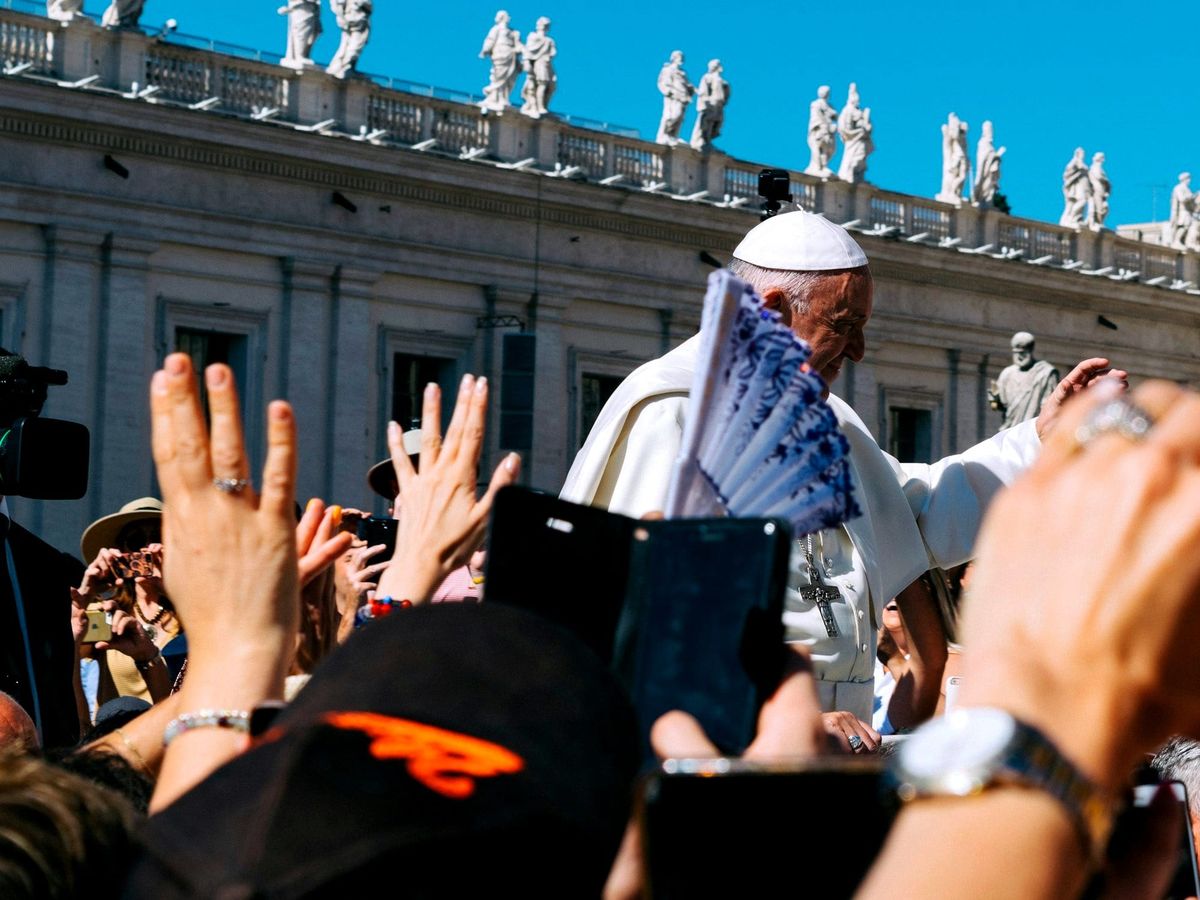
Audience with the Pope

A dialogue between the transformative and emancipatory components of both Christianity and Marxism, in order to make the elective affinities between them a common ground for changing social relations — this must be the sense of an encounter between the two cultures. 

In his speech of 10 January 2024, during the audience with a delegation from DIALOP (Platform of Dialogue between Marxists and Christians) Pope Francis stated that ‘at a time marked by conflicts and divisions at various levels, let us not lose sight of what can still be done to turn the tide.’

Ten years before, in a meeting with a delegation from transform! which launched DIALOP as a formalised process of dialogue between Christians and Marxists, Francis had stated that no single power in the entire world had enough forces to respond alone to the then most decisive problems of humankind: care for the Earth, our common home, the struggle against the dominant throwaway culture and the need to place the poor at the core of all politics.

The tide, to use the Pope’s words, kept getting more threatening since that historical meeting. It is a global threat made of a triple hegemony or perverse forces. First, the hegemony of war and violence as continuation of politics by other means. During the three decades of unipolarity that followed the end of the Cold War, liberal interventionism in both the internal and external peripheries of the world-system was wrapped in a discourse of transformation without war. The illusion that the world was approaching Kant’s ideal of perpetual peace was just that: an illusion. Global liberalisation was a social war cohabiting with military peace. In other words, the Cold War was succeeded by a cold peace, as all victors’ peaces are cold. However, the problem is that this cold peace of the unipolar moment is now followed by scenarios of hot war, because of the replacement of unipolarity by the typical disorder of multipolar reality. This is the time of the ‘Third World War in pieces’, as Pope Francis has called it. And this includes, with increasing likelihood, scenarios of nuclear destruction. 

The second hegemony that makes up the threatening tide we must face is the hegemony of resignation to climate catastrophe, as today expressed by governments and the most powerful political and economic actors. Despite repeated warnings from the global scientific community, political practice and economic dynamics are steadily cutting back nearly all the commitments that states have made in successive international agreements. The courage and creativity required for an effective and just energy transition are being replaced by stubbornness in preserving a mode of production and wealth accumulation that is responsible for the environmental disaster. The apparent peace of irresponsibility is the disguise of a war against the climate. 

The third hegemony that constitutes the threatening tide is the growing hegemony of the far right and its responses to the challenges of diversity, migration, women’s rights, and the rights to autonomy for all. The rise of the far right worldwide is fuelling strategies to push back equality and create an unequal hierarchy of rights. It deeply threatens social cohesion and the democratic construct, replacing them with violent polarisation and populist superficiality. The ideological war fuelled by the far right is a war against a society open to the rights of all individuals and against a social transformation that expands the universe of these rights.

The dialogue between Marxists and Christians makes sense as a common pursuit of counter-hegemonic perspectives that enable turning the tide and building a transversal social ethics whose central references are the full emancipation of individuals and peoples, a comprehensive ecology, and positive peace.

World War in Pieces

Can peace be another elective affinity between Christianity and Marxism? If so, on what terms? And is there a peculiar constellation of events that paves the way to turn that affinity into concrete proposals?

‘The world is being traversed by a growing number of conflicts that are transforming what I have repeatedly defined as the Third World War in pieces into a true global conflict’. This was the Pope’s warning in his address to the diplomatic corps at the Holy See earlier this year. And he added: ‘If we could fix each one of them [the civilian victims of wars] in our eyes, call them by name, and evoke their personal story, we would see war as it is: nothing more than a huge tragedy and a useless massacre that wounds the dignity of every person on this Earth’.

The alternatives outlined by Francis in the face of the escalation of global
war involve reallocating resources destined for armaments to establishing a global fund for the eradication of hunger and the promotion of sustainable development, political investment in multilateral disarmament negotiations, and the demand for compliance with international humanitarian law in ongoing conflicts.

But what stands out in this Pope’s thinking about the Third World War in pieces is that it does not arise merely, nor primarily, as an expression of the personal wickedness of political and personal leaders, nor of a state-centric geostrategic thinking feeding power at all costs. In Francis, war is one of the components of a social system (de)regulated by a throwaway culture. This culture  manifests itself in the preservation of a capitalist economic system that produces poverty and precariousness — the ‘economy that kills’, as he wrote, and that assaults the Earth, our common home, pushing it towards the climate catastrophe that will affect everyone, but especially the most vulnerable: the poor and future generations. It is this throwaway culture that forces the desperate flight of multitudes of migrants, exposing them to slavery, human trafficking, and even death.

War as an expression of a system rooted in throwaway culture is a formulation that brings Christians and Marxists closer. The Marxist conception of war as a result of imperialism, with this being conceived as an advanced stage of capitalist voracity for supply and consumption markets, ultimately grounds war in the exploitative essence of the capitalist mode of production. Exploitation in Marxist theory, the ‘throwaway’ in the Catholic construct — but in both, the same concern to see war as a phenomenon structurally founded in society. 

But this convergence between explanations of war is just one dimension of the possible common ground between Marxists and Christians in the face of the globalisation of the Third World War in pieces. The policies of response and alternative to war are the other dimension where there is room for debate and where it is more necessary than ever. Marxism and Christianity both refute the liberal fiction of the ‘war to end wars’ which, in practice, has only been a device for legitimising successive imperial wars. And both also distance themselves from a passive pacifism disconnected from social and economic reality. To both fictions, Marxism and Christianity oppose the urgency of social justice and positive peace.

Harmony and Conflict

Struggle among classes, peace among peoples. At the core of the Marxist culture lies the notion that social conflict is the engine of history, that the contradiction of interests between the ruling class and the dominated class is the central element of social reality, and that it is the permanent dialectic between these interests that leads to long advances and short setbacks in the historical process.

This positive and dynamic view of social conflict challenges a superficial and naive outlook, often embraced in the Christian field, which opposes it with a sort of universal call for harmony that confuses conflict with violence and, covertly, seeks to stifle conflicts and the differences of interests they express.

Now, Francis does not adopt this harmonistic view and proposes a much more complex conception which he calls ‘political love’ in the encyclical Fratelli Tutti: 

(...) love, overflowing with small gestures of mutual care, is also civic and political, and it makes itself felt in every action that seeks to build a better world. For this reason, charity finds expression not only in close and intimate relationships but also in macro-relationships: social, economic and political. This political charity is born of a social awareness that transcends every individualistic mindset: social charity makes us love the common good, it makes us effectively seek the good of all people, considered not only as individuals or private persons, but also in the social dimension that unites them (pars. 181 and 182). 

At the core of political friendship — as the antithesis of the exacerbation of individualism and the tendency to take inherent competition to the limits of the impulse for subjugation or even elimination of the other — is, therefore, social justice that gives cohesion and creates community.

The dialogue between Marxists and Christians today finds a privileged terrain in the identification of convergences on social-justice policies that neutralise the culture of war. What gives meaning to the centrality that both Marxists and Christians attribute to this strategic function of social justice is their common reference to the notion of positive peace. Conceptualised by Johan Galtung as the antithesis of violences — in the plural, to encompass not only physical violence but also structural and cultural violence — positive peace assumes a programmatic nature, a process, a dynamic of construction rather than simply a static denial of war. Positive peace is this program of social, economic, and cultural transformation that has emancipation as its guiding value and that aspires not only to end the most evident expressions of violence but also to act on the deeper and systemic determinants of violent conflict. Positive peace is peace far beyond pacification.

Join Forces

Yes, there is a peculiar constellation of events that not only allows but also demands for the elective affinity between Christians and Marxists concerning peace to become a concrete programme of action. It is nothing less than a terrifying constellation: European leaders’ acceptance of nuclear war as a possible scenario, the assumption of investment in the arms industry as a priority for the leading economies of global capitalism, and the impunity of genocidal strategies like the one being implemented in Gaza. 

Against this terrifying tide of militarisation and radicalisation of the Third World War in pieces, Christians and Marxists are called to join forces around a counter-hegemonic  perspective that gives absolute priority to social justice and positive peace at all scales.

The link has been copied!