

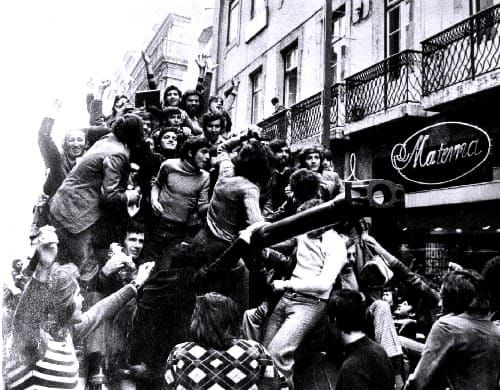
From its first day, the victorious soldiers’ uprising of 25 April 1974 triggered the explosion of a mass revolutionary movement — a real earthquake that overturned the established order at all levels of Portuguese society. This movement tried to create and articulate new democratic forms of organisation and expression of the popular will in thousands of companies, in the working-class neighbourhoods on the outskirts of cities, in the fields of the South, in schools, in hospitals, in both local and central state bodies — and even in the armed forces.
In its different offensive periods, this revolutionary movement occupied factories, the big agricultural estates (latifundia), and empty dwellings; discovered self-management and workers’ control; imposed the nationalisation of the banking sector and the main strategic sectors of the economy; purged bosses and administration councils; created Collective Production Units for the Agrarian Reform; and managed the lives of thousands of poor residents from North to South. Taking over the streets, this movement’s energy imposed public freedoms, the political democratisation of the state, the destruction of the hardcore of the previous regime’s repressive apparatus, and the persecution of its culprits. At the same time, it won the right to strike, trade-union freedom and the foundations of a new social justice. This was truly a period that turned the world upside down — nineteen months in which the future was now. It was a short and rare moment in which ordinary women and men, the people of labour and exploitation, dreamed of taking their destiny into their own hands. This period has been referred to as the Portuguese Revolution of 1974–75 — and rightly so, I think.
From military coup to revolutionary explosion
This revolution has a first key particularity that is usually not given much attention. It was triggered by a military coup unique in the long history of coups in nineteenth and twentieth century Portugal. For this was a soldiers’ movement borne out of weariness with a colonial war which had been dragging on for thirteen years, with no possible victory in sight: an unjust war, waged against the winds of history, and which was ruinous even in the short term. In a country that the dictatorship prevented from speaking for itself, the discontent against the war would — in one of those ironies in which history is so fertile — be expressed by the young officers who led it in the field, the captains and majors who commanded the army companies, the base units of the colonial occupation.
In other words, this was not a plot by generals, admirals and colonels ( who were loyal to the regime and the war effort till the end, with a few well-known exceptions). It was a conspiracy that — in a context of growing popular discontent as well as the political and ideological atmosphere of the times — quickly evolved from corporate-professional goals (which, incidentally, the government had satisfied in October 1973) to a subversive political purpose. From September 1973 to March 1974, from the officers’ plenaries stretching from the Lisbon area to the South, the movement would clearly recognise the need to overthrow the regime. Without democratisation, there would be no political solution to ending the war.
The swift spread and politicisation of the middle-ranking officers’ conspiracy, and their control or neutralisation of the majority of the main operational units of the three branches of the armed forces, thus created a situation that, though not immediately noticeable, would prove decisive. It drastically deprived the state and the military hierarchy of operational strength. In other words, it transformed this hierarchy — in reality, and in its oath of obedience to the regime — into what was popularly labelled a pathetic and useless ‘rheumatic brigade’. A head without a body and unaware of not having one. But it also took that power of intervention away from the rare dissident generals who were convinced that they had a kind of private military coup in their hands. The first hours of ‘25 April’ and its aftermath were a bitter surprise both for the loyal commanders in the hierarchy and for General Spínola and the officers who followed him. During that long night from 25-26 April in the Pontinha barracks, where the movement’s general staff had taken shelter, the Spinolists had close contact with an Armed Forces Movement (MFA) that was willing to make some programmatic concessions regarding the colonies, but totally unwilling to give up its place in the process that was to follow.
This leads to a second central characteristic of the revolution: the neutralisation of the traditional role of the armed forces. The victory of the movement of the middling officers actually broke the armed forces’ hierarchical chain of command, removed them from the traditional control of the state and its appointed leaders, and thus paralysed their role as the central organ of organised state violence. In this sense, strictly speaking, the armed forces ceased to exist and were succeeded by the MFA — which was something quite different. This latter would soon control the bulk of the most relevant operational military power through COPCON (Continental Operational Command). During this initial period of Spínola’s leadership, until its defeat on 28 September 1974 at the earliest, there was a desperate struggle by the remnants of the old hierarchy (which, incidentally, was largely purged during the ‘Night of the Generals’ by the mutinous officers on 6 May) to eliminate the MFA as the de facto organ of power. The defeat of Spinolism thus confirmed this kind of neutralisation of the armed forces as the backbone of state violence.
This had another important consequence: the paralysing, pulverisation and general weakening of state power and authority. What emerged from the military coup was a combination of conflicting and weakened powers: a National Salvation Junta with no real power in the armed forces, a Provisional Government with no powers over the armed forces, and with the police forces and ministries paralysed, a Council of State with largely rhetorical powers and, outside of this institutional logic (although represented in the Council of State), the Coordenadora of the MFA Programme, the only seat of effective power, but in strong dispute with the Spinolist faction in the armed forces and other bodies. The old power had fallen, it no longer threatened anyone, and it left a vacant field vulnerable to a drastic change in the power relations on a social and political level.
Finally, the process described above had another effect: the short-term cessation of the colonial war on all three fronts (Guinea, Angola, Mozambique) and the formation, both in the contingents in Africa and in Portuguese public opinion, of a strong movement refusing new shipments of troops to the colonies, demanding the littoralisation (i.e. concentration in coastal areas) of the military apparatus and the return of troops, pressing for the immediate opening of negotiations with the liberation movements on their terms, or, in the war zones, replacing combat with fraternisation with the ‘enemy’. Strictly speaking, in political-military terms, the colonial army surrendered, accepting its defeat. The colonial army and public opinion refused to carry on with the war. Decolonisation was thus to be negotiated by the MFA and the Provisional Government, with no public opinion in favour of any way of prolonging the conflict, no armed forces willing to continue fighting and no international support for anything other than self-determination and independence for the peoples of the colonies. The end of the empire had begun.
The conjunction of the factors listed above (the erasure of the armed forces’ role as the central guarantor of ‘order’ and the deliquescence of state power) with the strong political and social tension accumulated in the final period of the Marcelist regime, led to the revolutionary explosion. The mass movement, which was largely spontaneous by virtue of one of those ‘mysteries’ that characterise revolutionary situations ripe for action, had, on the very morning of the coup — the emblematic outcome of the confrontation at Ribeira das Naus and Rua do Arsenal played a part in this — the double intuition that it could and should take the initiative. It had the intuition of the moment and the intuition of its own strength: ‘It’s now, because they no longer have the army: we’re stronger than them’. It had the near-intuitive understanding that the correlation of forces, at that unwinnable moment, was in favour of the popular initiative. And from being a spectator, the mass movement became the main actor. Before the military coup, on its own, despite its strength and radicalism, the mass movement couldn’t overthrow the regime. But now it seized the opportunity offered by this particular military movement, storming through the ‘doors that April opened’. The coup, contrary to Communist leader Álvaro Cunhal’s attempt to restore the old narrative of the ‘national uprising’, was not in itself the armed expression of the ‘popular insurrection’ (initially, he even wanted to avoid it...), it was not the revolutionary explosion. But due to its particular characteristics, it would decisively contribute to triggering it.
The Ongoing Revolutionary Process (PREC)
In its unstoppable initial momentum, between May and September 1974, the revolutionary popular movement conquered much of what was essential on the streets, in factories, in working-class neighbourhoods and in schools, in the countryside: the foundations of political democratisation, fundamental public freedoms, the abolition of the organs of political repression and censorship and the fascist militias, well before all of this was legally enshrined. Political democracy in Portugal was not bestowed by the powerful. It was a popular conquest, imposed on power. The same goes for social democratisation, the right to strike, freedom of association, the minimum wage, paid holidays, a reduction in working hours, the foundations of a universal social security system or the occupation of vacant houses by poor tenants. The mass movement did all this while facing the systematic opposition of the National Salvation Junta, the Provisional Government, and even the leadership of the Portuguese Communist Party (PCP) and the Intersindical, which at that stage were invested with the role of guardians of the ‘democratic order’ against ‘irresponsible leftism’. However, it was the strength of this movement that proved decisive in defeating the first counter-revolutionary attempt by Spinolism on 28 September 1974, to some extent imposing the MFA as the hegemonic political-military force in the process.
From October 1974 onwards, the economic crisis, the closure or looting of many companies by the fleeing bosses, for skyrocketing unemployment, changed and radicalised the patterns of action. Workers occupied companies and, from January onwards, the estates of the agrarians in the southern regions of Alentejo and Baixo Ribatejo, experimented with self-management or called for the intervention of the state or the MFA, trialled various types of workers’ control and did so through Workers’ Committees or neighbourhood committees elected by them. Keeping companies afloat, defeating economic sabotage and securing jobs soon raised the issue of the nationalisation of strategic sectors of the economy (starting with the banking sector). This goal was achieved in the aftermath of the defeat of the Spinolists’ second counter-revolutionary attempt on 11 March 1975. The nationalisation of the banks (in practice, the large financial groups) was approved and the Agrarian Reform, which was already underway, was legalised. Workers’ control was on the agenda. The revolutionary process seemed to be taking a step forward. In reality, this was the last step.
In fact, the diverse camp of the revolution would suffer three successive and decisive defeats in the following months. It wasn’t just the modest results in the April 1975 election of the PCP (12.5 per cent), the MDP (4.1 per cent), the MES (1.02 per cent) and the UDP (0.7 per cent): it was the uncontrollable effect in changing the perceived criterion of legitimacy for power. In reality, what happened was that, electoral legitimacy was definitively imposed over revolutionary legitimacy. And the truth is that the Socialist Party (PS) won the constituent elections with 37.8 per cent of the vote. The revolution could neither postpone nor ignore, much less annul the election (which was unthinkable in a country where the opposition had forever upheld the banner of free elections). Nor did it have the strength to win it.
The crisis of legitimacy that afflicted the revolutionary camp could not even be compensated for by the military vanguard’s claim to be the ‘guardian’ of the future democratic institutions, as was meant to be established in the first MFA/Parties Pact. The Communist Party’s self-centred strategy, aggravated since the turn of March 1975, underpinned by an instrumental use of the current ideas of a certain military vanguardism on the left of the MFA (the famous ‘people/MFA alliance’), doubly aggravated the splits in the revolutionary camp. Firstly, between its various components,with some Maoist organisations responding to the Communist Party’s offensive by considering it the ‘main enemy’, while those that didn’t go so far still viewed it with criticism and distrust.
The far left had enough social and political strength to hinder and dispute the political-ideological hegemony of the Communist Party, without, however, managing to impose an alternative path.
But, more importantly, this crisis of hegemony alienated a large part of the intermediate social sectors that did not see the totalising hegemony of the Communists or ‘people’s democracies’ as the model of the future society to which they aspired — and also did not see the radical left as an alternative. It was precisely after the April 1975 elections that they started to abandon the uncertain field of the revolution.
However, it doesn’t make sense to say that the Communist Party had given up on seizing power or that it hadn’t even defined a strategic line to this end. It consciously applied the so-called Ponomariev strategy to control power: to gradually take over vital sectors of the state (municipalities, intelligence services, the military apparatus), nationalise the media, the trade union apparatus, and call for the ‘mobilisation of the street’ when this process somehow got ‘clogged up’. It was a concealed action, often resorting to force and administrative control processes, which began to generate strong reactions in society, particularly in the world of labour, local authorities, public opinion, the military, etc. The legitimacy crisis in the revolutionary process and its internal fragmentation largely derived from this kind of bureaucratic authoritarianism established by anticipation.
In any case, the different sides became more extreme and the consensus that had previously sustained the political-military institutions after April 1974 was broken with the explicit and open rupture of the camp that, in the name of democratic socialism or the ‘European model’, opposed the camp of the socialist revolution (the definition of which was far from clear or consensual). The Fourth Provisional Government fell with the resignation of the PS and the PSD, and the growing and already undeniable disintegration of the MFA
became clear. Far-right terrorists took action across the country against left-wing organisations and activists, and the Catholic hierarchy distanced itself from the ‘Ongoing Revolutionary Process’ on the pretext of the occupation of Rádio Renascença. Mass mobilisation against the revolutionary process began with large rallies and demonstrations called by the Socialist Party in favour of parliamentary and ‘European’ democracy and the concentrations in support of the Episcopate in the north and centre of the country. In fact, in July 1975, with the formalisation of the ‘Group of 9’, a political-military camp was formed, with the ‘Nine’ and the Socialist Party at its core, in opposition to the divided revolutionary camp. It would now go to fight for key positions in the military apparatus and the government, as a first step towards defeating the revolutionary process in terms of social mobilisation. This was a camp openly supported by the political and economic right wing, by Maoist sectors that emphasised the danger of a regime under the tutelage of the Communist Party and, more in the shade but better known today, by the broad reach of the fascist and terrorist far-right groups of the ELP/MDLP and similar.
The second defeat of the camp of socialist revolution, in August/September 1975, was the removal of the ‘military left’, especially the so-called ‘gonçalvista’ wing closest to Vasco Gonçalves and the Communist Party, not only from the leadership of the Provisional Government but also from their strong positions in the military apparatus. The V Division was closed, Gonçalves was removed as Prime Minister and prevented from taking up the post of Commander in Chief of the Armed Forces, the ‘gonçalvists’ were placed in a minority in the Council of the Revolution losing 9 councillors, and the councillors of the ‘Group of 9’ were reinstated. The new Sixth Provisional Government marked a clear shift to the right. Otelo Saraiva de Carvalho and COPCON remained, but this last core of the revolution in the military immediately began to be besieged. What emerged from this clash was a substantial change in the military and political correlation of forces: in the leadership of the three branches of the Armed Forces and in the government, there were now opponents of the revolutionary course. It wasn’t yet the end, but it was the preface to the end.
With the revolutionary process in progress, it wasn’t enough to stop the leaders of political power and even the military leadership from resolving the situation. The ‘counter-offensive of the popular struggles’, as the Communist Party put it, would be strong and indeed longlasting. But this already represented, despite its mobilisation capacity between September and November, a clearly defensive process against the ‘advance of the reaction’ and the imminence of a military coup, in reality prepared by the ‘group of 9’ since the ‘cleansing’ that had occurred that summer. To consider this final radicalisation, almost desperate and without clear direction, as the ‘insurrectionary moment’ or the ‘final assault’ on state power seems to be an approach that has little to do with reality. The important mobilisations of that period, in general, did not address the issue of seizing power: they reclaimed lost positions, and denounced the political-military plans, which were indeed offensive to the counter-revolutionary camp — in short, they were on the defensive and trying to secure what had earlier been obtained. However, in the absence of a unified mass movement and a clear political direction, this was not incompatible with being drawn into the incipient coup adventure led by the paratroopers and the COPCON units of the Lisbon Military Region (RML) with the support of some trade union sectors linked to the Communist Party and some of the far left, with the occupation of air bases, strategic points in Lisbon, the RTP (National Television Broadcast) and the National Radio Broadcaster (Emissora Nacional/EN).
This was the long-awaited pretext for unleashing a serious military countercoup, which eventually took place on 25 November 1975. What is revealing in this context is the astonishing ease with which, with virtually no resistance (apart from a brief confrontation at the Military Police barracks), the Regiment of Commandos subdued the rebel units one after the other. The few hundred people who were ‘defending’ them dispersed and their military leaders went to the Belém presidential palace in a disciplined manner. Once consulted the COPCON military units in the RML and stalled the marines’ action (the only force capable of confronting the commandos), the Communist Party ordered the Intersindical and the revolutionary defence committees to demobilise. Cunhal wouldn’t jeopardise the Communist Party by going into adventures. He preferred to negotiate. The third defeat was now definitive for the revolutionary process.
Novembreism
Novembreism was to the counter-revolution what the 25 April military movement had been to the revolution. It was not the counter-revolution itself, but the change in the correlation of forces that it imposed which paved the way for the gradual, progressive and constitutional establishment of the counter-revolution as the dominant policy of the post-revolutionary situation. Stealthy and prudent, it walked through the doors that November had opened. On 25 November, the coup ordered the arrest of 118 military personnel, sacked 82 workers from the RTP and EN and dismissed the administrations and directors of the nationalised press, who were replaced by people from the PS and the PSD or similar military personnel. But contrary to the wishes of the far right and certain sectors of the right, there were no mass arrests of the ‘reds’, cancellation of public freedoms, dissolution of parties or shutting down of trade unions or their publications. The PCP remained in the Provisional Government and the 1976 Constitution would enshrine the goal of socialism, the irreversibility of nationalisations, the Agrarian Reform, workers’ control and the role of Workers’ Committees.
In fact, according to several coinciding oral sources, the ‘Group of 9’ seems to have discreetly negotiated an agreed containment of the revolutionary process with the Communist Party. It had been instigated by a kind of an ‘invisible’ command of Gonçalves or COPCON officers, less controllable from a party point of view, from the SDCI, which resulted in a process that was obviously different from a classic, violent counter-revolutionary response.
Certainly, the revolution was coming to an end. But it left on the succeeding parliamentary democracy the genetic imprint of its political and social conquests. This was the legacy of the rights and freedoms which it had wrested in the revolutionary struggle, whose continuation it had imposed and which would have to be defended in the new political situation. The schematic equation often made between the counter-revolution and parliamentary democracy ignores the fact that, in Portugal this latter was itself the product of a revolutionary process, which left a deep mark upon it. Contrary to what the political and historiographical right wing claims — in a curious alignment with the aforementioned point of view — political democracy does not exist in Portugal despite the revolution, but because of the revolution.
To be and not to be
Therefore, there is a to be and a not to be in the Portuguese revolution of 1974-75. The revolution had the strength to overturn the established order, striking the very foundations of the capitalist system. But it was unable to secure and, even less so, deepen these acquisitions into a lasting socialist power. The revolution was stopped in its tracks and lost most of its most advanced achievements in the meek counter-revolution established with the ‘democratic normalisation’. In other words, the revolution was contained by the formidable reactions it sparked both nationally and internationally. This leads to the necessity of trying to analyse, albeit briefly, some of the main difficulties it faced. I will briefly address three aspects that seem most important to me.
Firstly, the situation of a semblance of ‘dual power’ created by the thousands of organs of popular will elected in the companies, neighbourhoods, and countryside of the South by the workers and tenants. It is a given that they never managed to form a single, articulated national organisation. Much less, in their dispersion, did they assume a clear political orientation or pose the question of seizing power. Unlike what happened in the Russian soviets of 1917 or in the German council revolution of 1918-19, in the Portuguese revolution there was no unified parallel ‘people’s power’, which is why the question of ‘all power to the organs of the people’s will’ was never raised in practice. Until July 1975, the Communist Party and its trade union structure opposed the Workers’ Committees (CT) elected in the workplace and, before and after that, each political group on the radical left had ‘its’ CT and CM (Tenants’ Committees elected in the neighbourhoods); these were ‘their’ structures of partial articulation, often warring with each other as well as with those that the PCP eventually created that summer.
Secondly, in the Portuguese revolution, the organs of popular will were not armed, again in essential contrast to the aforementioned soviet and council experiences. Such bodies were supported by an external ally, a military movement of junior officers (or part of it), or even by some units, as the left of the MFA split. There were no workers, peasants or soldiers in arms, as claimed by some sectors of the radical left. In addition, the Communist Party and the radical left-wing organisations maintained organisations in the armed forces, more to influence the MFA officers than to promote insurrectionism among the soldiers, with the exception of the short-lived and hopelessly belated experience of the SUVs (United Soldiers Will Win), which was explicitly opposed by the various tendencies in the MFA. In these terms, the revolutionary process of the workers was externally supported, if at all, by an increasingly divided and weakened officers’ movement. The vulnerability was obvious: if and when the reaction to the revolutionary process succeeded in re-framing the MFA in the military chain of command, eliminating it, the mass movement, even if it remained, would lose its indirect armed and subversive expression, returning to the nature of a protest movement without the capacity to raise the question of power. It would turn instead to defence. This is precisely what happened.
Thirdly, the political arena of the revolution was deeply divided politically and ideologically over the nature of the power to be built and the paths to get there. And there was neither a clearly hegemonic force capable of dragging down or marginalising the others, nor the ability to find a minimum platform for common action. The Popular Unity Front (FUP) — formed on 25 August 1975 between the Communist Party and seven other groups with clearly defensive purposes and without the participation of the Maoists — began to fall apart three days later with the PCP’s departure. The central divergence was between Cunhal’s strategy (of progressive occupation of the civilian and military apparatus of the state, the MFA, the leaderships of the unions and newspapers/radio/RTP, local councils, etc... often on the margins of any real democratic scrutiny, from the ‘top down’), and the orientation common to the radical left of creating in the class struggle a ‘popular power’ capable of launching a revolutionary assault on the state, but without any glimmer of consensus or convergence on how to proceed. But even in the subfield of the far left, the war of sectarianism around revolutionary ‘purity’ was generalised. And all of this, of course, was reflected in the lack of cohesion of the MFA’s left wing, which was already splitting with the ‘group of 9’.
In truth, one of the singularities of the Portuguese revolution, which the ideological prejudice of much of the historiography on this period tends to hide, is that the far left, although pulverised and internally at war, had enough social and political strength to hinder and dispute the political-ideological hegemony of the PCP in the process, without, however, managing to impose an alternative path, let alone any kind of common platform of understanding. This deadlock in the camp of the revolution opened up a war in its midst where sectarian violence on all sides was often not only verbal, but also gave rise to aggression, purges, manipulation and even mass repression in an attempt to politically eliminate the Maoist camp that was most hostile to the PCP. This
conflict-ridden blockade naturally alienated unstable or disillusioned social allies, showed impotence in the response to reactionary forces, expressed disunity and weakness, and isolated this camp within itself. In it, we can trace some of the reasons for the inability to successfully resist the counter-offensive in summer 1975 and what followed.
In conclusion, it is fair to say that the Portuguese revolution was not brought to a close by the events of November 1975. The seismic force that exploded on that ‘whole and clean initial day’ was not enough to win, but it did make it possible to strongly shape and limit what followed. In essence, and certainly in a contemporary way, it is still around the defence, consolidation and expansion of this heritage, or its opposite, that the political struggle in Portugal is defined.